


Why is this in your inbox? Part of Hexa Media, Underdogs is a podcast and newsletter by Augustin Celier for bootstrapped founders who want to turn years of hard work into the outcome they deserve. Drawing on his experience as both entrepreneur and investor, Augustin explores the choices that can transform a solid company into an exceptional one. Unsubscribe from future notifications here.
There’s a pattern I see in almost every bootstrapped company past €2M ARR.
The founder does everything: product decisions, sales calls, hiring, ops, customer escalations: everything flows through them. They’re surrounded by a team of junior people, because that’s what the budget allowed. And for years, it worked.
It worked because in the early days, being everywhere creates value. You learn every inch of your market, build intuition, and make fast decisions because all the context lives in your head.
But at some point, that same behaviour starts destroying value.
You become the bottleneck of every decision. You centralise knowledge that should be distributed. You de-responsibilise your team without realising it. You slow the whole company down.
The shift from founder-led to executive-led is one of the hardest jobs in scaling. Most founders either attempt it too early (and hire people they can’t afford), or too late (and burn out trying to do it all). Many try and fail, then convince themselves that delegation is impossible and only they can do the job.
That’s wrong, but I get why it feels true.
This is how we built an executive committee at Veevart - five C-levels in nine months - and what I learned helping Antonio, the founder, make that transition.
Step 0: Realise you have a problem
When I met Antonio, Veevart was doing well. Great product, loyal customers, real traction in a niche market. But Antonio was running everything himself, supported by a team of mostly junior people he managed directly.
He didn’t see it as a problem. As a bootstrapped founder, this felt like the only option. Senior hires were expensive. Delegation meant more work, not less: you delegate a task, then spend hours reviewing it, fixing it, explaining it again.
Antonio couldn’t envision a world where leaders would bring him solutions, not problems. Where entire chunks of the business would get out of his head and stay out.
My first job as his Partner was to keep insisting that this world exists. You can build a team you trust to solve whole parts of the company. To solve problems, not just execute tasks.
He started believing it when he met the first candidates I brought to him. People who had done it before, who didn’t need to be managed, but unleashed.
That mindset shift is the first unlock. Without it, nothing else works.
Step 1: Know when you’re ready for it
There were two signs that Veevart was ready for an executive committee.
Veevart was post-product-market-fit, and Antonio’s involvement in everything was having diminishing returns. At the beginning, doing things yourself enriches your vision. But past a certain point, you’re just slowing things down. If every decision waits for you, you’re the problem.
Second: they had the budget to hire A-players. This matters more than people think. If you don’t, you’ll fall into the classic trap: hire someone who can only do part of the job, feel relieved to finally delegate, watch it not work, fire them, and conclude that delegation is impossible.
It’s not impossible, you just hired the wrong person because you couldn’t afford the right one.
Step 2: Find your A-players (and be patient)
At Veevart, we assembled a full executive committee in nine months - five C-levels. It was extremely fast, but it felt painfully long.
You’re looking for profiles that almost don’t exist. Your checklist is too long and too specific. The best people don’t necessarily want to join your company - by definition, if they’d raise your talent bar, they have options.
So it’s a sales exercise. You need to sell your vision, your trajectory, and the team you’re building around them. The best hires join because they see potential, not because you’re already there.
Two lessons I learned:
1. Be patient and keep searching. The moment you meet the right person, you’ll know. Don’t settle before that moment.
2. Be ready to sell, and do it well. You’re not interviewing them. You’re convincing them to bet on you.
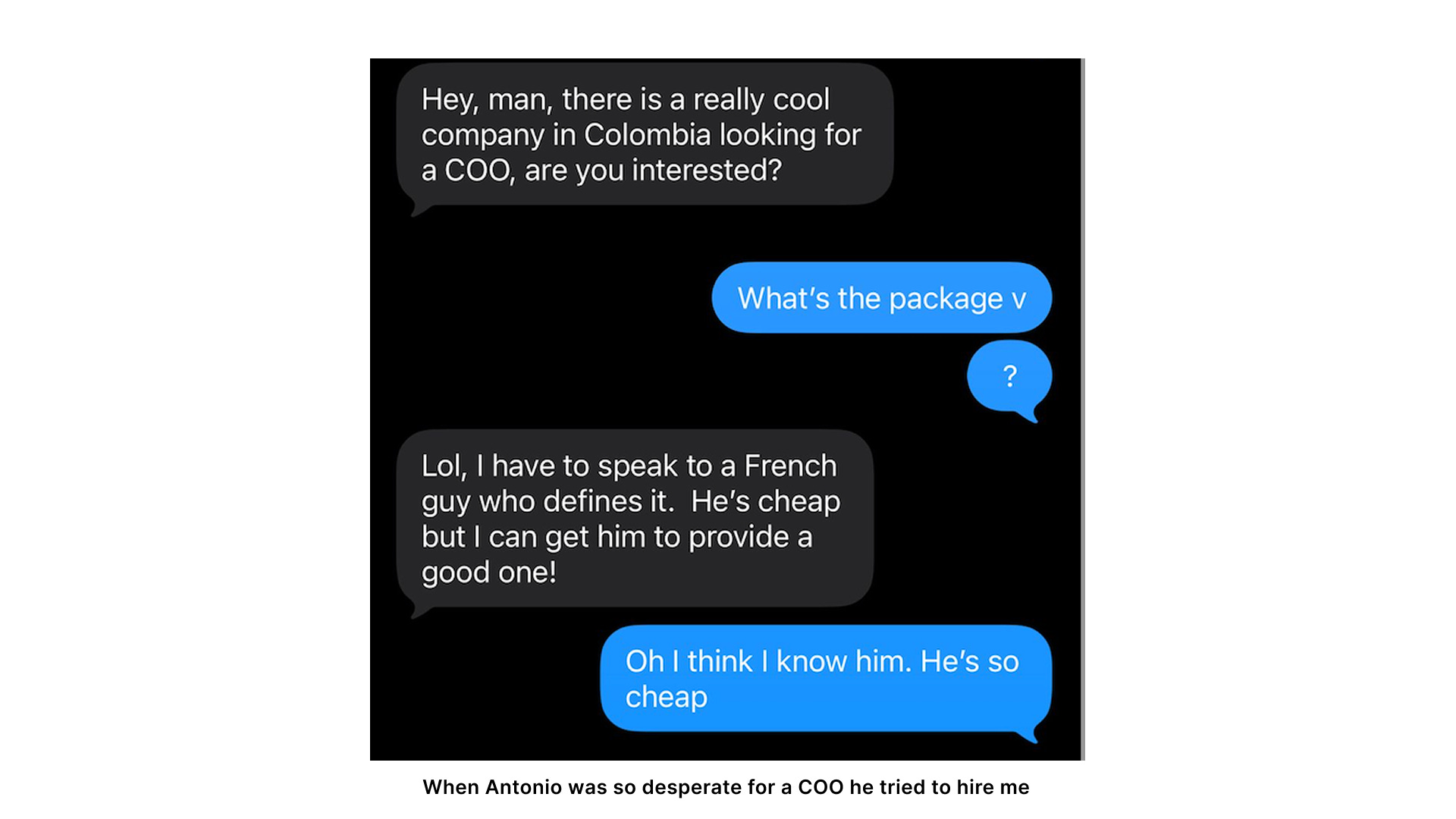
For the COO search, Antonio and I had different bars. He kept pushing for candidates who could do part of the job, profiles that would help in the short term but wouldn’t get us over the bridge we needed to cross. I kept saying no, because I knew that hiring the wrong person here would set us back a year.
After six months and dozens of candidates, we finally met the right one. There was no shadow of a doubt, and Antonio felt it too.
Step 3: Get them to work together
So you’ve got your A-players. They’ve taken whole chunks of the business off your plate, and that’s great. But the real magic happens when they start operating as a team rather than siloed superstars.
I don’t believe in team-building centred around entertainment. Escape games and cocktail nights create a fake image of bonding. At best, you learn how to have fun together, but you don’t learn how to work together.
Real team-building happens in the work, on hard problems, together.
With an executive committee, there are two levels of cooperation:
Strategic cooperation. Get your leaders in a room and make them work on company direction at a short offsite - not a retreat, a working session. Vision and priorities get challenged. Everyone has a say. You want them to fight over goals and budget allocations. You want them to own where the company is heading, with you.
Operational cooperation. This one is tricky. Getting all your C-levels in a single room is the most expensive time allocation in your company. Most of these meetings will feel painfully useless - especially for you, the founder, who already knows everything being discussed.
But I’ve learned that these meetings aren’t for you. They’re for your C-levels to learn what the others are doing. That information exchange is necessary.
More importantly, you need to turn these meetings into a space for hard discussions. Surface the conflicts of interest between departments. Arbitrate them as a team. That’s where each C-level rises above managing their silo into managing the company.
At Veevart, we’re still building this out, so no war stories to share yet. But the early signs are there. The team is starting to challenge each other. Decisions are getting made without Antonio in the room, that he approves. That’s the goal.
The real unlock
Building an executive committee is less about delegation, and more about fundamentally changing what kind of founder you are.
You go from being the person who solves every problem, to the person who builds the team that solves every problem. It’s uncomfortable, you might feel a bit useless for a while. You’ll wonder if you’re still needed. You are, just differently.
Your job becomes holding the vision, staying obsessively close to your market, and knowing where to go next. And every single day, enabling your C-levels to succeed - removing blockers, providing context, setting them up to win.
And when it works, when you watch your team make a decision you would have made, without you - that’s when you know the company can scale beyond you.
This is the second article of Underdogs, my newsletter about the bootstrapped founders who build quietly and aim for something big.
