


We’re currently publishing a new chapter of The 10x Method every week, our sold-out book detailing Hexa’s early-stage methodology that built 50+ companies, 3 of which are unicorns. You can unsubscribe from future drops here.
In 2016, two founders on opposite sides of the world had the same idea: a better way to take notes. One was working quietly on the first version of Notion. The other was building Slite. They didn’t know each other. They hadn’t copied one another. The truth is, the world was simply ready for that idea.
That’s the thing about startup ideas, they don’t usually come from lightning bolts or shower thoughts. They come from timing, noticing the shift in what’s possible, or seeing something broken or outdated, and realizing that now, finally, it can be done differently.
People often think of startup ideas as one-liners. But the best ones are more like frameworks that emerge from action, pattern recognition, and curiosity, not from waiting until we have a eureka moment.
In this chapter, we’ll show you what a startup idea really is, how to tell a weak idea from a strong one, and how to find ideas worth pursuing. You’ll learn the three types of startup ideas, the signals that matter, and the simple frameworks we use at Hexa to stress-test potential ventures before we write a single line of code.
Our goal is to help you go beyond “I have an idea” and move toward “I have a well-thought-out plan to build something exceptional.”
What’s a startup idea?
An idea is much more than a problem to solve
A lot of the startup advice out there simplifies building a startup into just identifying a problem and solving it. As a result, many founders spend their energy searching endlessly for problems to tackle. While this advice isn’t incorrect, it’s overly simplistic and limiting.
A robust startup idea is multidimensional. It must include:
The problem → what specific pain point or need are you addressing?
The solution → what product will you build to address this problem?
The Go-To-Market strategy → how will you ensure your solution is known and used by customers? And how will it capture value

Perhaps part of the confusion arises from the word “idea” itself. It reminds us of a sudden flash of inspiration or a Eureka moment, something captured in a single catchy sentence. But a genuine startup idea is in fact more structured than this “aha” moment.
Rather than calling it a “startup idea”, it might be more accurate to describe it as a “startup framework.” This framework isn’t static, it’s something you continuously explore and refine through research, feedback, and real-world testing.
“At the very beginning, what matters most is finding the right problem to solve and making sure you’re building the right solution for that problem. Until you have that, everything else is noise.”
– Rodolphe Ardant, Cofounder of Spendesk
Every great startup innovates somewhere
At the heart of every successful startup lies innovation. Innovation doesn’t necessarily mean creating a groundbreaking technology or inventing something entirely new from scratch. Instead, innovation involves rethinking at least one key dimension of your idea:
Problem: discovering and addressing a previously unnoticed or unaddressed problem.
Solution: creating a totally new product that didn’t exist before or a signifi- cantly improved solution.
GTM Strategy: developing an entirely new or more effective method to acquire customers or deliver your product to the market.
Excelling in just one area can be sufficient to create substantial value and differentiation in the market. For instance, innovating primarily in your GTM strategy can significantly expand your market reach, even if the problem and solution are already well-known.
Not all ideas are equal
You’ve probably heard the line: “It’s 99% execution, 1% idea.” It sounds good and practical but like most startup clichés, it’s only half true.
Even the most talented founders struggle to succeed if they start from a bad idea. Meanwhile, a well-timed, well-formed idea, even in the hands of an imperfect team can go surprisingly far.
Execution is the engine, but the idea is the map. If you start driving without one, you can end up working incredibly hard... in the wrong direction.
So before you pour in months of effort, take the time to ask the hard questions and validate your idea - using our framework that we’ll explore below. Not all ideas are worth building. The trick is knowing the difference.
How Stewart Butterfield the founder of Slack had a bad first idea
Stewart Butterfield’s journey is a really interesting example of how even exceptional founders can stumble initially due to a flawed idea. Butterfield, known today as the visionary behind Slack, initially invested his passion and resources into a gaming startup called Glitch, an online multiplayer game designed around creativity and exploration. Despite significant investment and effort, Glitch struggled to attract an audience and eventually shut down due to its failure to resonate broadly enough with users.
However, the end of Glitch became the unexpected beginning of something much bigger. In developing Glitch, Butterfield’s team had created a custom internal messaging platform to enhance communication and workflow among employees. Recognizing its potential, they pivoted from the game to refining this communication tool, ultimately launching Slack. Unlike Glitch, Slack quickly found product-market fit, dramatically reshaping workplace communication by significantly reducing dependence on emails and fostering collaborative team environments. The idea’s inherent strength transformed Slack into a global success, eventually leading to its acquisition by Salesforce for $27.7 billion.
Butterfield’s story illustrates the importance of starting with a strong idea, no matter how skilled the execution, success ultimately hinges on an idea that genuinely meets a need.
How to find an idea
The three categories of startup ideas
To effectively find startup ideas, it’s essential to first understand the three distinct categories they typically fall into. Throughout this section, we’ll give you our framework of the different types of ideas and provide actionable strategies for identifying ideas within each type.
“Curiosity is everything. If you want to build a company, you need to stay open to industries, conversations and problems without knowing in advance which thread will lead to your big idea... Ideas emerge when you stay close to real problems and pay attention to the pain points others overlook.”
– Nicolas Saison, Cofounder & CPO of Swan
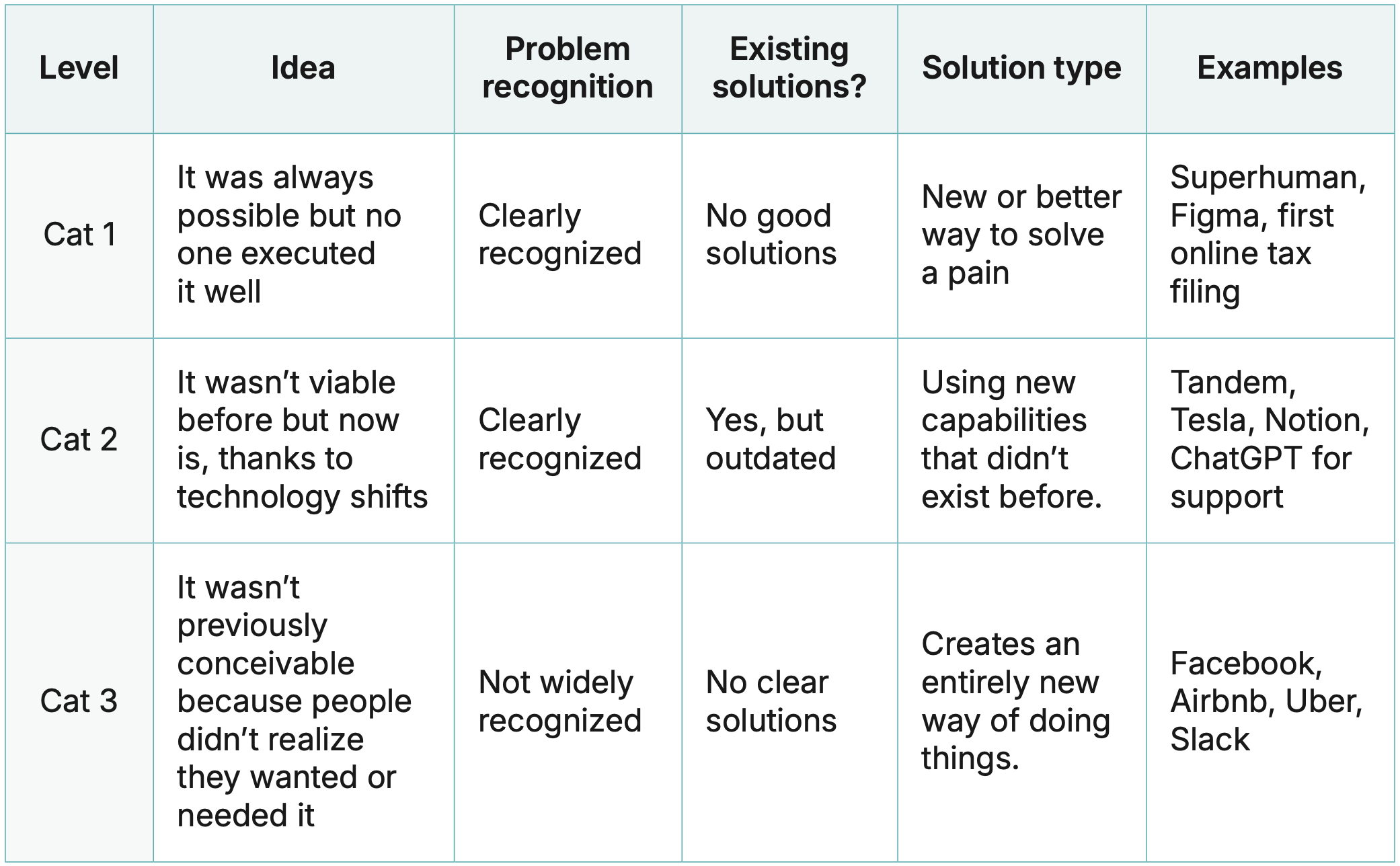
There are three main categories of ideas:
Category 1: a problem-solution fit
Category 2: a market or technology shift
Category 3: a category creation
Category 1
Source of the idea: often comes from a personal frustration, industry knowledge, or insight into a market.
The problem: it exists today and is clearly recognized and felt by a specific group, and people are actively looking for a better solution. There may be no existing solution, or the available options are bad or outdated.
Solution type: you create a new or better way to solve an already known issue.
Example: Superhuman → born from personal frustration and deep user insight.
Its founder, Rahul Vohra, observed that despite being a mission-critical tool, email had become slow and joyless, especially for power users like executives and founders. Rather than relying on a new technology break- through, Superhuman focused on obsessive UX, speed, and thoughtful features to reinvent the email experience. The problem was obvious; the innovation was in crafting a better solution for a well-understood need.
How to find them:
Tap into personal frustrations: think of annoying, repetitive tasks you encounter regularly. Are there products or services you’ve used that feel outdated or inefficient? Chances are, if you’re frustrated, others are too.
Leverage industry expertise: reflect on jobs you’ve held or industries you’re familiar with. What processes seem broken or overly complicated? Industry-specific insights often reveal problems that outsiders might not see.
Engage with industry experts: VCs, investors, and founders see a high vo- lume of startup ideas and understand which problems are worth solving. Ask investors what types of companies they are excited about and what major pain points remain unsolved in their sectors.
Observe what people are already trying to solve manually: anytime you see people building workarounds, copy-pasting between tools, hiring extra help, using Notion or Google Docs to track something, that’s often a sign that no good product exists yet.
Examine existing solutions critically: look at the tools, software, or services available. What features are missing? Where do reviews or online forums show consistent dissatisfaction? These gaps are opportunities to offer something better.
Category 2
Source of the idea: Comes from a new technology, market trend, or regu- latory change that makes solving an existing problem dramatically better, faster, or cheaper.
Problem: it is already recognized and solved by existing solutions, but new technology enables dramatically better ways to solve it.
Solution type: you rethink the solution using new capabilities that didn’t exist before.
Example: Figma → Figma would not have been feasible five years earlier. Its core differentiation, real-time multiplayer editing in the browser, has been made possible only because of recent advances in web technologies like WebGL, WebAssembly, and CRDTs (conflict-free replicated data types). The “aha” wasn’t just that design tools needed collaboration; it was that now, for the first time, we could bring a Google Docs-like experience to a traditionally desktop-native category.
How to find them:
Become an expert in the emerging technology of your choice: stay updated on advances in AI, web3, green tech, or other cutting-edge fields. When
you understand what the tech actually makes possible, and its current limits, you’ll start to see which old problems can be solved in totally new ways.Track market and regulatory changes: New laws or regulations often unlock previously blocked opportunities. For example, GDPR created demand for better data privacy tools.
Talk to users in legacy industries: Professionals in fields like law, logistics, finance, healthcare, or government often know their tools are outdated, but they may not know what’s now possible. Your role is to connect the dots between what’s painful and what’s newly possible.
Map existing problems against new capabilities: Pick a known industry or workflow (e.g. expense reporting, insurance claims, knowledge manage- ment) and ask: How would this work if it were invented today, with the new tools we now have? This reframing often reveals huge efficiency gains or user experience upgrades that legacy players can’t easily deliver.
Evaluate recent startups and failures: study what worked and what didn’t. Sometimes a startup fails because the market wasn’t ready. If conditions have changed, the idea might now be viable.
Category 3
Source of the idea: a paradigm shift and dramatic change in human behavior that create opportunities for entirely new ways of doing things.
Problem: it may not even be recognized by the market yet, as users haven’t identified it as an issue that needs solving. Often, these problems are deeply embedded in existing behaviors or accepted as “just the way things are” until an innovative solution reveals a better alternative.
Solution type: instead of improving something that exists, the startup creates an entirely new way of doing things.
Example: Airbnb → before Airbnb, staying in a stranger’s home wasn’t seen as a viable or safe alternative to hotels, and homeowners weren’t thinking
of their spare rooms as income-generating assets. The problem wasn’t clearly defined but Airbnb uncovered a latent opportunity. The break- through wasn’t technological, it was behavioral. Airbnb created an entirely new way of thinking about lodging. It challenged cultural norms, built systems to create safety and reliability (reviews, identity verification, secure payments), and shifted what people considered acceptable when traveling, effectively creating the peer-to-peer hospitality category.
How to find them:
These are definitely the hardest ideas to find, but they also offer the greatest potential rewards.
Study behavior, not just problems: ideas often emerge when you observe people doing things inefficiently, inconsistently, or with hacks, even if they don’t complain about it. Watch for friction people have simply accepted as “normal.”
Explore cultural shifts and changing norms: big behavioral shifts often change how we do things and our mindsets. Pay attention to how younger generations communicate, travel, learn, work, and spend. What are they doing differently from the past, and what does that open up? The rise of the sharing economy came with shifting attitudes toward ownership , enabling platforms like Uber, Airbnb, and Depop.
Question assumptions: challenge existing conventions. What if people didn’t have to own something to use it? What if processes that seem standard (e.g., commuting to an office) could be completely rethought?
The different types of startup ideas
Insight from Florent Quinti, Partner at Hexa
Today’s AI startups provide a perfect illustration of category 2 where a technology shift enables a better solution.
Today’s AI boom is a textbook example of a market or technology shift unlocking dramatically better solutions to known problems. The underlying problems - like customer support inefficiencies, content creation, document summarization, internal knowledge retrieval - have existed for years and were previously tackled through human labor or traditional software tools. With the arrival of large language models these same challenges can now be addressed faster, cheaper, and with far less manual intervention.
What makes this shift particularly fertile for startup ideas is how horizontal AI is: it touches nearly every function across industries. For example, the rise of AI agents in enterprise software reflects a rethinking of user interfaces and workflows, that used to be static forms can now be context-aware and thus personalized.
Founders who understand the underlying AI capabilities are in a unique position to revisit mature categories, like CRM, legal tech, finance, or education, and rebuild them from first principles, unlocking 10x improvements in speed, cost, or user experience.
Insight from Thibaud Elzière, Cofounder and Partner at Hexa
Ideas belong to their era, not to people
Great ideas are rarely unique. They tend to appear in multiple places at once because the conditions are ripe for them to emerge. In 2016, I had the idea for a simpler, more collaborative note-taking tool, that became Slite. That same week, I discovered a remarkably similar product on Product Hunt: an early version of Notion. It wasn’t plagiarism or bad luck. It was just that the world was ready for that idea.That experience taught me something foundational: ideas belong to their time, not to their creators. They emerge at the intersection of cultural shifts, new technologies, and evolving user behaviors. The best entrepreneurs aren’t necessarily the first to think of something, they’re the ones who recognize when an idea’s moment has arrived and move fast to bring it to life.
The best ideas are born from action
You don’t find startup ideas by sitting around and waiting for inspiration. You find them by doing. Building companies, launching products, talking to users, testing tools, this is how you spot real problems and hidden opportunities. Every conversation, every experiment, every failure is a potential spark.This is what I call building your ‘idea muscle’. People often think ideas come naturally to me, but it’s a habit I’ve built through years of practice. The more you engage with the world, especially from the inside, as a builder, the more patterns you start to see. You’ll notice inefficiencies, gaps, and signals that others miss because you’re close to the action.
And when you do stumble on something that excites you, even if it feels small, don’t let it fade. Talk about it, build something, test it quickly. Momentum matters more than perfection. An idea without action is just a passing thought.
Avoid rigid market analyses
One common trap is overanalyzing markets in a mechanical, top-down way. It feels productive to map out sectors, compare market sizes, and list competitors, but this often leads to obvious, uninspired, or already crowded ideas.In my experience, good ideas don’t come from spreadsheets, they come from energy. From instinct. From something you saw, felt, or experienced that made you say, “there has to be a better way.” That’s why I prefer starting with the user, not the market.
Make sure it’s innovative
Once you’ve landed on a startup idea, your work isn’t done. Now it’s time to stress-test that idea using the framework introduced earlier:
A startup idea = Problem + Solution + Go-To-Market Strategy.
Every strong idea needs to innovate in at least one of these three areas. If it doesn’t, you may not have an idea worth pursuing, at least not yet.
This approach can also help you discover new ideas. Even if you find that your solution addresses an existing problem that already has solutions, you can still be innovative by developing a completely new go-to-market strategy.
Spotlight on Hexa’s portfolio
Several of our early companies, Mailjet, Mention, Aircall, Textmaster, and Front, emerged from problems Thibaud Elziere identified at Fotolia, where developers were spending too much time building internal tools. As Hexa expanded, we discovered new opportunities through challenges we faced while launching our first companies and running Hexa itself (leading to Swan, Spendesk, and Folk). Later, the emergence of web3 and AI inspired us to rei- magine software in new ways.
Examples from Category 1
Swan
When Upflow founders Alexandre Louisy and Barnaby Malet attempted to integrate third-party BaaS providers, they quickly ran into significant challenges.
That experience led us to build Swan, a developer-first BaaS platform that was modern, well-documented, and much faster to deploy. It wasn’t about inventing a totally new technology or inventing a category, it was about improving it, based on deep firsthand pain.
Folk
Folk started as an internal tool. We just wanted a better way to manage our contacts as a team, something between a CRM and a shared address book. Spreadsheets were clunky, CRMs too rigid. We built something small, just for us. But once we shared it, we realized how many other teams felt the same pain. That’s when we decided to turn it into a real product. The need was obvious once you had lived it, but almost invisible from the outside.
Examples from Category 2
Spendesk
Spendesk was born from a common pain point observed by both the Hexa team and the Spendesk founders: in some companies, employees were literally photocopying the company card to handle expenses. This small, easily overlooked behavior revealed a much deeper structural issue in how businesses manage spending. Around the same time, a new technology was emerging, the digital wallet, enabling companies to issue and control virtual or physical payment methods.
Instead of just building a better expense report tool, the Spendesk team flipped the model: what if every employee could access secure, trackable payment methods with built-in controls?
Aircall
The initial insight came from Thibaud Elziere’s time at Fotolia, where the
team relied on Skype to manage customer support across multiple countries. Skype’s ability to generate local numbers that redirected to an online application was clever, but it broke often and clearly wasn’t built for business. Still, it pointed to something bigger.
But the technology was shifting. Cloud infrastructure made it possible to build software without integrating with legacy telecom stacks. WebRTC, the technology behind Google Meet, was getting standardized and deployed widely, enabling any browser to become a phone app. And lastly, teams were moving toward more collaborative tooling, thanks to companies like Atlassian and Slack.
Put it all together, and the opportunity was obvious: build a fully cloud-based phone system, designed for modern teams from day one.
Tandem
In the past, customer success was human-led, or support was limited to static help docs and chatbots. Now, with embedded AI copilots, Tandem reimagines support as context-aware, real-time, and continuous, tailored for each user, inside each tool.
Without recent advances in LLMs and embedded AI, this type of seamless support layer would have been impossible. It’s a perfect example of taking a known problem (users struggling with software) and using emerging technology to solve it in a 10x better way.
Multis
Multis was a web3 company we launched in 2018, born from our desire to deeply understand an emerging technology by building within it. We spent months exploring the web3 ecosystem hands-on not with a fixed idea, but with the conviction that expertise comes from action. By immersing ourselves in the space, we uncovered a clear pain point: web3-native companies were completely underserved when it came to managing their finances. It’s a textbook Category 2 idea: the problem was known, but only with the rise of web3 infrastructure could a truly native solution emerge.
Tengo
Tengo uses AI to analyze tender opportunities, summarize requirements, and auto-fill key parts of the application. This was technically impossible until recently. With LLMs, Tengo turns dense legal and administrative documents into manageable workflows. A classic case of AI unlocking access to an old, painful process.
Examples from Category 3
Front
At first glance, Front seems like a classic Level 1 idea: solving the well-known pain of shared inbox chaos with a better, collaborative interface. But dig deeper, and you can make a strong case that Front actually helped create a new category - collaborative email - and nudged users into a different behavior paradigm. Traditionally, email was seen as a private tool. Teams that needed collaboration often resorted to hacks but rarely questioned the premise that email itself could be a shared workspace. Front redefined how teams could work through email together, with features like internal comments, assignments, and analytics baked into the inbox.
What makes this feel like Level 3 is that the problem wasn’t always explicitly stated by users. Many teams had accepted clunky workarounds as “just the way it is, and hadn’t yet imagined email could be truly collaborative. Front had to educate the market, change expectations around what an inbox could be, and essentially invent a new category: the shared collaborative inbox platform. Much like how Slack reframed internal communication away from email, Front reframed email itself. That’s classic Level 3: uncovering and solving a latent problem by introducing a better way of working that changes behavior.
“Looking back, my perspective on category creation is that it’s incredibly hard. A great example of a company that did this really well is Qualtrics. They created the “Experience Management” category and even introduced a new job title: Experience Manager. But I think this approach is only really valuable if you’re selling to large enterprises. For most other companies, I actually think creating a category is a mistake. I know that’s a controversial opinion, lots of companies have proven otherwise. But the reality is, most customers - especially SMBs - don’t care if what you’re building is “new.” They have a problem and they just want it solved.”
– Mathilde Collin, Cofounder of Front
How to validate an idea
Validating an idea isn’t a one-time checkpoint, it’s a continuous, iterative process. At Hexa, we’ve developed a simple but powerful three-step approach that’s helped us validate over 50 startup ideas, and invalidate many more. This framework doesn’t guarantee success, but it ensures we never build blindly.
Here’s the process we follow every time:
1. Become an expert
2. Scope the idea
3. Create wireframes
Become an expert
Even when you’re experienced in a sector, it’s tempting to jump straight into building. But relying solely on your own perspective is risky. To build so- mething truly useful, you need a deep, nuanced understanding of your users, their goals, workflows, frustrations, and context. And the only way to get that is by spending time with them.
This starts with a simple principle: genuine curiosity. Great validation doesn’t come from proving your assumptions, but comes from challenging them.
The best way to get close to the problem is to talk directly to the people living it. A good rule of thumb is to interview 25–30 people in your target audience, ideally through 30-minute calls. You’ll notice that once you’ve completed enough interviews, your learning curve starts to flatten. We call this the 80% rule: aim to learn 80% of what there is to know. Don’t get stuck chasing the remaining 20%, you’ll discover it as you build.
Here are a few best practices we’ve learned over time:
Observe workflows, don’t just ask about them. Ask users to show you how they currently do things. Often, they can’t articulate pain points directly, but you’ll spot them in action.
Ask short, open-ended questions. Your best tools are “Why?”, “How?”, and “Can you show me?”. Let users talk as much as possible - you’re here to listen, not pitch.
Avoid leading questions. Stay neutral and open. If you’re fishing for valida- tion, you’ll get it, and it won’t be worth anything.
“To refine the idea, we ran over 100 discovery meetings across one year. Even though we couldn’t sell anything yet (we had to wait 18 months to get our e-money license), we uncovered 25 use cases. That discovery work was critical to shaping the platform. In every call, we’d start by asking, ‘Tell me about your company and the problems you’re solving.’ Then we’d just listen. We weren’t inventing new use cases — we were fitting into payment flows that already existed. Only after understanding their world would we map our solution to their needs.”
– Nicolas Saison, CPO and Cofounder of Swan
“Users never told us directly, ‘Hey, build something for security form filling.’ But they’d casually mention the tools they used for it.”
– Christophe Pasquier, CEO and Cofounder of Slite
Scope the idea
Once you’ve developed a solid understanding of your users and the problem you’re solving, it’s time to get specific. That means moving from abstract insight to a clearly defined concept: what exactly are you building, for whom, and why now?
At Hexa, we’ve learned that writing things down is a critical part of validating an idea. It’s a way to force clarity. Scoping the idea early helps you confirm that:
You’re solving a real, well-defined problem
You understand who you’re solving it for
The product you’re planning to build is a logical, focused response to that problem
You’re not trying to do too much too soon
Here’s our template:
Summary
In one sentence, what are you building?
Problem
What is the problem you’re solving? Who’s experiencing this problem (persona? in what kind of companies)? What’s the frequency and the intensity of the problem?
Solution
What product will you need to build to solve the problem? You need two things here:
A precise scope for the MVP
Including in the 2nd iteration mockups/wireframes and/or detailed functional definition of what you want to build
A longer term vision of the product you want to build
Get into the details of your software (interfaces, workflows, inputs, outputs, interactions with the user, data structure...)
Implementation
You need here to be able to articulate how the product works for the user: how they will setup their software, what they will do with it, what is the input, the output...
Go-to-market
What kind of personas/ICP do we want to target? How are you going to find the first 100 users? What will the business model look like and how will we capture enough value?
In the longer term, how do you see GTM evolving?
Market size
To start with an idea, we don’t need a precise market sizing, but rather insight on how this can become a big market and how we can build a company larger than $100m ARR. What geographical areas do we want to target?
Opportunity
Why now? What have you understood that other people haven’t?
Competition
Brief list of players in the same space
Hypotheses
What do you need to believe in order for your startup to be successful?
Discovery
What do we need to test in discovery interviews to confirm the opportunity? Whom could we interview for this?
Create wireframes
Once the idea is scoped, the next step is to make it visual. Wireframes are one of the most powerful tools in early-stage validation, and one of the fastest ways to bring clarity to what you’re building. No styling, no branding,no pixel-perfect mockups, just clean, low-fidelity layouts that show what the product does, not how it looks.
At Hexa, we never skip this step. We always build a quick set of wireframes, typically 3 to 4 key screens, within the first few days of shaping an idea. It’s the fastest way to turn abstract thinking into something tangible, something you can point at and challenge together.
That said, wireframes at this stage aren’t always visual screens. For a vocal AI agent, they might be audio interactions or dialogue flows; for an API-first product like Swan, they might take the form of a first draft of API documentation.
More on how to build low-fidelity wireframes in chapter IV.
The timeline for idea validation
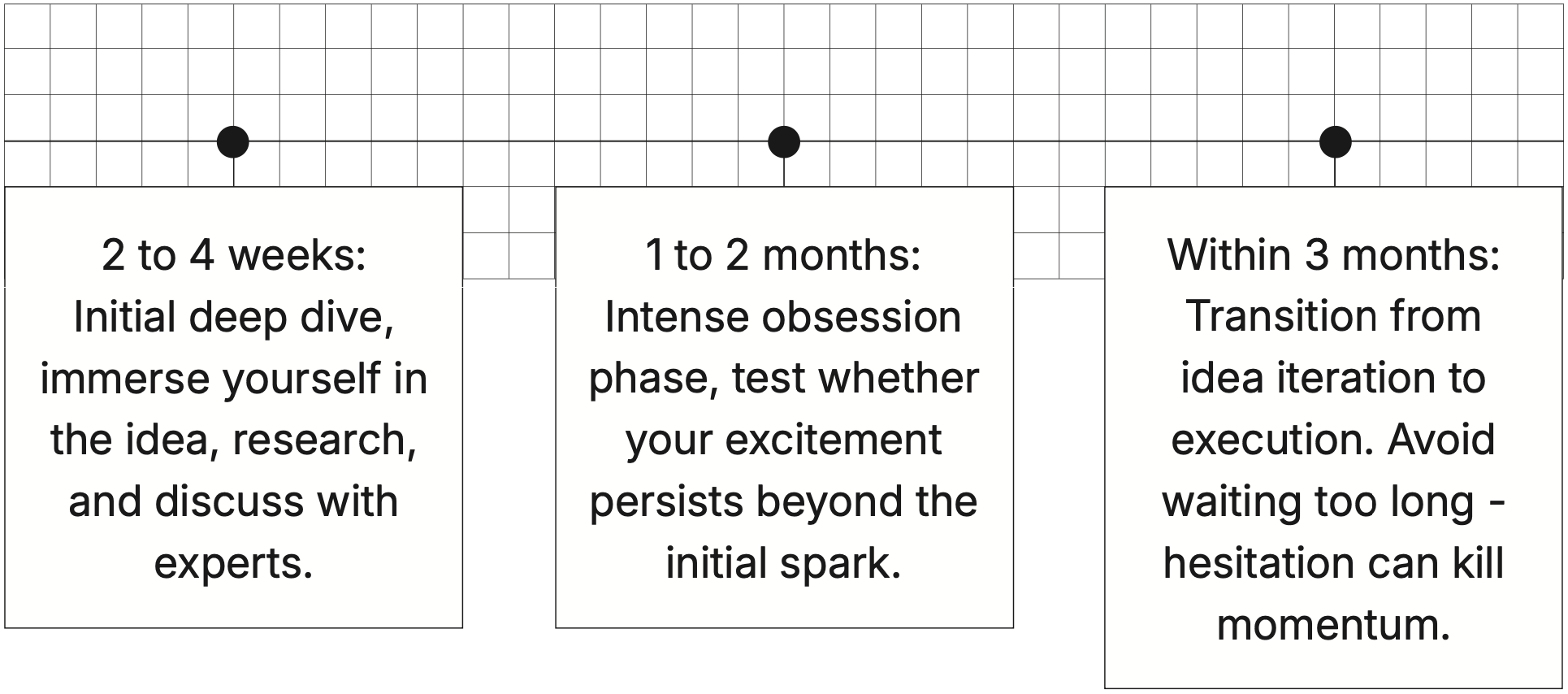
Insights from Quentin Nickmans, Cofounder and Partner at Hexa
Signs you shouldn’t validate your idea
You’ve lost the spark. If the idea no longer excites you, don’t ignore that feeling. Building a startup is hard, if you’re not energized by the problem, it only gets harder.
Customers don’t actually care. You’ve talked to potential users, and the feedback is lukewarm at best. They wouldn’t pay for the solution, or worse, they don’t even see the problem. That’s a vitamin, not a painkiller.
The market is too small. Even if the product works, the upside just isn’t big enough to build a venture-scale company.
VC interest is drying up. If funding in the space is shrinking, ask why. It could signal structural issues with the market or a technology that is about to be replaced. Which doesn’t signal anything positive.
Signs you shouldn’t give up on your idea
A major competitor is launching. Don’t walk away just because a big competitor shows up. Back in 2014, we scrapped our plans to launch an eSignature company after a major player hit the market with a massive funding round and a bold promise: eSignature would be free for everyone. It shook us. But here’s the twist — that company had actually been building in stealth for 18 months and eventually launched... with a paid product. The space wasn’t closed. There was still plenty of room to innovate and win with a different vision. The lesson? Don’t get spooked by noise.
Market experts tell you it’s a bad idea. Deep conviction matters more than expert approval. Look at Aircall. At the idea stage, Aircall called some early investors and experts in the Telco space to ask if the concept made sense. The answer? “You’re crazy, landlines are dead, the future is mobile.” Every expert said it was a bad idea. But they were wrong. Aircall found fast, strong product-market fit. Why? Because they stayed focused on the user problem and ignored the noise. Industry insiders often have blinders on, they see the risks, not the opportunity.
Hexa ideas that didn’t pass the validation stage
One of the fastest ways to understand what makes a great idea is to study the ones that didn’t make it. The ideas we didn’t pursue often reveal just as much as the ones that did.
FRANCHISEx
The pitch:
FranchiseX is the all-in-one platform for franchisors to manage and scale their franchisee networks. From onboarding new locations to improving perfor- mance across the network, our goal was simple: help franchisors grow, faster, smarter, and with less operational overhead.
Why we didn’t validate:
After speaking with customers and investors, we realized the market just wasn’t big enough to build a breakout company. The pain existed, but the upside was capped.
WEALTHx
The pitch:
WealthX is an AI-powered workspace for wealth management firms and advisors. By streamlining workflows and automating routine tasks, it helps advisors and assistants focus on higher-value activities, ultimately driving better client outcomes.
Why we didn’t validate:
Too few customers control too much of the market. Nearly half the revenue comes from just 50 firms, and the next 26% from another 500. That means missing one major player, especially in a country like France, means missing a meaningful chunk of ARR. On top of that, the product wasn’t enough of a wedge to become the operating system for wealth managers. It felt anecdotal next to core software.
FREIGHTx
The pitch:
Carriers, brokers, and 3PLs waste hours on manual tasks, quoting, order processing, customer service, ops management. These inefficiencies kill margins and limit growth. AI agents purpose-built to automate these workflows could dramatically improve efficiency, service quality, and scalability.
Why we didn’t validate:
This wasn’t the right market to launch in. Margins are thin, and the customer base is either huge enterprises or deeply entrenched legacy SMEs, both hard to access and not feeling acute productivity pain.
More importantly, Europe lacks the kind of fragmented, independent freight brokers that exist in the U.S. Freight in Europe almost always crosses borders, making it a game of corridor-based freight forwarders rather than small brokers managing hundreds of carriers. Without those small players, the wedge disappears.
Excellent article that effectively highlights the importance of Design Thinking in the creation of a Startup 💎https://www.ideo.com/journal/build-your-creative-confidence-the-dream-gripe-session