


We’re currently publishing a new chapter of The 10x Method every week, our sold-out book detailing Hexa’s early-stage methodology that built 50+ companies, 3 of which are unicorns. You can unsubscribe from future drops here.

Two of the most common causes of startup failure are not finding product/market fit and co-founder issues. And while the first gets most of the attention, the second can kill a company before it even gets off the ground.
There’s no universal formula for successful co-founder matching. The origin stories vary, some teams are forged out of long-time friendships, others come together fast around an idea or within a startup program. Some partnerships feel like family, others remain strictly professional.
After matching over 100 founders at Hexa, we’ve seen clear patterns in what works and what doesn’t.
The best co-founder relationships tend to be built on three key ingredients:
1. Complementary skills and personalities
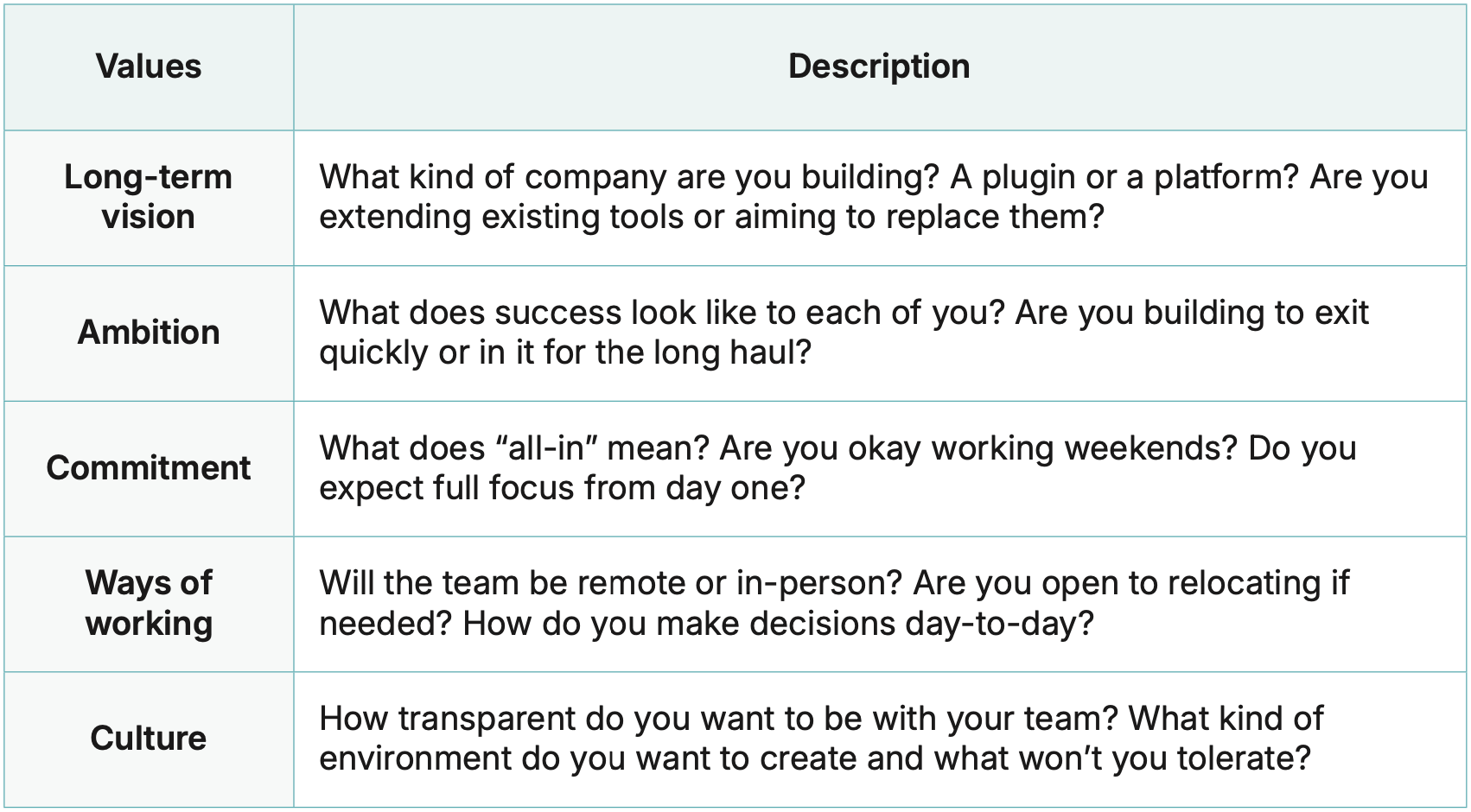
2. Alignment on 5 non-negotiables values
3. Transparency, trust, and communication
This chapter breaks down each of these key ingredients, how to evaluate them early, and how to reinforce them over time so the partnership stays strong.
What makes a great cofounder team
Yes, we think having a cofounder is essential - especially if you’re building a software company. You need both technical and business expertise not just on the team, but at the founding level. In software, the product is the technology. Early decisions about architecture, scalability, speed of development, and user experience can define your company’s trajectory. These choices require deep ownership, something you only get when the person leading the technical side is a true cofounder. Conversely, you need business expertise at the founding level because building a great product isn’t enough, you have to position it, price it, distribute it, and fund it.
Why you shouldn’t be solo
Having a co-founder increases your odds of success because of three reasons:
Reason 1: You can’t be great at everything. No one is. A good cofounder fills your gaps. Between technical, product, go-to-market, people, finance and more, there are a lot of areas of expertise you need to cover. We’ll go deeper on that later, but for now: skill range matters, and you rarely get it all in one person.
Reason 2: Startups are hard and lonely. Building something from scratch is emotionally intense. You’ll have days where you feel unstoppable, and others where you’ll question the whole thing. A cofounder won’t make the chaos go away, but they’ll be in it with you. And that makes a huge difference.
Reason 3: You make better decisions, faster. Every founder goes down the wrong path at some point. You get excited by a new direction, overcommit to an idea, ignore a red flag. The difference is whether you have someone to help catch it early. A cofounder helps you make decisions faster, but also course-correct faster. And that can be the difference between a three-week distraction and a six-month detour.
“We’re radically transparent and never hold back. To outsiders, it can look like we’re arguing but what they’re seeing is intensity paired with deep respect. We’ll say things like, ‘No, that’s nonsense, here’s how we fix it,’ and move forward without ego. That combination of honesty, challenge, and mutual care is why we make better decisions together.”
– Nicolas Saison, CPO & Cofounder of Swan
Two is the sweet spot
For most B2B software companies, having two cofounders is an optimal setup. It gives you the benefit of complementary strengths without the complexity of a larger founding team. One founder brings technical expertise, while the other focuses more on business, operations, or go-to-market, but the most successful pairs co-own the strategy, vision, and major decisions.
Sometimes though, two isn’t enough.
If the business model is more complex, or the first two cofounders don’t fully cover the core skills needed to build and run the company, a third cofounder can help close the gap. This is especially true in operationally intense businesses (like ecommerce or logistics), or regulated industries (like fintech), where operations or compliance are critical business functions.
Take Swan. It was built around three cofounders: CEO, CTO, and CPO. Nicolas Saison joined as cofounder and CPO to lead both Product and Compliance, the latter being essential in a regulated space.
But it only works when each founder has clear and complementary ownership. When that’s not the case, adding a third person can actually create more confusion than clarity.
And while three can be the right number, going beyond this rarely is. Larger founding teams tend to slow down decision-making and blur accountability.
Three ingredients
We believe that a good cofounder relationship has three essential ingredients:
1. Complementary skills and personalities
Founders should bring different strengths to the table. One might be a visionary builder, the other a sharp operator. One thrives on product intuition, the other’s obsessed with numbers. It’s also about personality. Is one more optimistic while the other brings healthy skepticism? The goal is to balance each other out and not be the exact same person.
“The strongest cofounder relationships are built on radical complementarity, so clear and natural that there’s never any doubt about who takes what. In 15 years, with my cofounder Thibaud, we’ve never had to ask who’s taking the lead on something. That clarity comes from deep mutual respect and a shared understanding of each other’s strengths. Emotional complementarity matters just as much: when one of us is down, the other steps in. That kind of relay builds real resilience.”
– Quentin Nickmans, Partner and Cofounder of Hexa
2. Alignment on the 5 non-negotiable values
3. Transparency, trust and communication
Most co-founder breakups don’t happen suddenly. They develop gradually through misaligned expectations, poor communication, and issues that go unaddressed too long. The best co-founders prevent this by talking regularly, engaging in honest disagreements, and giving direct feedback.
“We did a lot of offsites together, especially in the beginning. We lived together. Worked together. Ate and argued together... A strong cofounder relationship is part trust, part alignment and part friendship. You don’t have to be best friends, but you need to like each other, respect each other, and believe in the same mission.”
– Olivier Pailhès, Cofounder of Aircall
How and where to find one
Expect that it will take time and volume
To find your co-founder, you should think of it as a sales process. You need to actively build a funnel. Most people you talk to won’t be the right fit, and that’s okay.
At Hexa, most founders who successfully find their partner:
Talk to at least 20 people properly before things click
Take 2–3 months to find the right person
Spend 2+ hours of their day on it - treating the search like an integral part of their daily job, not an afterthought
You don’t need a fancy CRM, but if you’re juggling lots of conversations, a simple tracker helps you stay clear on where momentum is building.
On a simple Notion, Google doc or Airtable, track four things:
Who you’ve contacted
Who you’ve spoken to
Who you want to keep exploring with
Who you want to nurture for your future first hires: because even if someone you meet doesn’t fit your criteria to become a founder, they might make an excellent early employee so do not forget them!
Make your project discoverable
If you’re serious about finding a cofounder, you have to show them what they’d be joining.
Don’t hesitate to post on social media saying you’re looking for a cofounder, especially if you pair it with what you’re building and where you want to go. And no, sharing your idea won’t get it stolen. At Hexa, we’ve always been open about our early-stage ideas when looking for cofounders, and not once has someone run off with one. The fear of being copied is usually much bigger than the actual risk.
Leverage your network
The ideal situation to find yourself in is to team up with someone you already know. Someone you’ve worked with before, collaborated with on a side project, and hopefully even navigated messy problems with. That kind of shared history takes a lot of the unknowns off the table. You already have a sense of how they operate, not just when things are going well, but when things are uncertain or tense.
A lot of these people will already have jobs, but don’t assume they’re unavailable, uninterested, or too far along in their careers. Make the ask. People’s situations shift quickly, and a well-timed conversation can unlock something unexpected.
“Nico [Benady] and I have worked together three times now. We’ve known each other for 21 years, and I think that’s the key to Swan’s success. Going into building Swan, we already knew we were like yin and yang, and we knew it worked. His strengths are my weaknesses and vice versa. We complement each other really well. Nico is a visionary, a dreamer. He’s always thinking five years ahead, while I focus on what we need to do in the next six months to execute that vision. I can dive into details across five different teams in a single day without any issues. Nico, on the other hand, needs space to breathe and step back, but he’s amazing at synthesizing complex problems into one punchline that makes everyone go, “Ah, that’s what we need to do.”
– Nicolas Saison: CPO and cofounder, Swan
It’s also worth asking people you admire: “If you were starting something tomorrow, who would you want to cofound with?”
You’ll get names you wouldn’t have thought of, people who’ve earned deep trust.
Spotting entrepreneurial intent
You’ve exhausted your network and still nothing? You can also start by reaching out to people directly. But intent is hard to spot. Most people don’t have “open to co-founding a startup” in their LinkedIn bio. That doesn’t mean they’re not interested, it just means you need to read between the lines.
The key is to look for signals. You’re hunting for mindset as much as skillset. People who’ve built side projects, written about startups, or worked at early-stage companies might have that entrepreneurial itch, even if they’re not shouting it.
You can use targeted keywords to surface the right people and filter for potential cofounder energy.
Here’s a non-exhaustive list of keywords that can be useful in your search to detect that entrepreneurial intent:
Founder: sounds very obvious, but it’s actually even better if they pop up as ‘founder’ in a previous position rather than current. This signals they’ve done it before, know how hard it is, and might be ready to try again. At Hexa, being an ex-founder of a failed startup is a big green flag. It means they’re familiar with the trials and tribulations of entrepreneurship and know what they’re getting into.
Stealth startup: or titles such as “Working on something new.” It usually means they’re in the very early stages. While that implies they already have a project in mind, you have no idea how it’s going - if they’re stuck, alone, or not feeling it, they might be open to teaming up.
Chief of Staff (for business founder): Chiefs of Staff work closely with founders, see how companies are built from the inside, and often take on an immense amount of responsibility across ops, fundraising, hiring, and strategy. Many of them are itching to lead something themselves.
CTO as a service/Staff Engineer (for tech founder): ‘CTO’ alone is a mixed bag. Some CTOs are very hands-on, others haven’t touched code in years. Keywords like “CTO as a service”, “Fractional CTO”, or “Staff Engineer” tend to surface people who are still very much in build mode. They’ve got seniority and they’re used to being a one-person tech team - perfect for an early-stage cofounder role where they’ll be actively building from day one.
How to make sure they’re the right cofounder
There are plenty of great cofounder questionnaires out there and they’re all useful. But instead of listing every possible question, let’s zoom in on what actually matters most when assessing a potential cofounder.
At the core, you’re looking for alignment on the three key ingredients:
Complementary skills and personalities
Transparency, trust, and communication
Alignment on 5 non-negotiables values:
- Long-term vision
- Ambition
- Commitment
- Ways of working
- Culture
The key questions to ask
Assessing complementary skills and personalities
You have to start by looking inward. Before you can evaluate someone else, you need to understand your own strengths and gaps.
Self assessment questions:
What energizes you?
What kind of dynamic drains you?
Who brings out your best work and why?
What kind of people or situations create friction for you?
Here are some questions you can ask when you’re ready to start assessing complementarity of skills and personalities:
Questions to ask potential cofounders to assess complementarity:
What are you great at that you genuinely enjoy doing?
What do you not want to be responsible for?
If we started tomorrow, what part of the business would you naturally take ownership of?
What’s one thing you’ve done in past roles that you’d want to avoid doing again?
How do you recharge when things get intense?
Remember, you’re not just assessing hard skills, you’re also looking at perso- nality complementarity, which can be a bit trickier. It’s less about ticking boxes and more about trusting your gut. Try to gauge whether your personalities complement each other without clashing. One key way to avoid conflict down the line, even if your personalities are quite different, is to make sure you’re aligned on core values.
Assessing the five non-negotiable of value alignment
The harder layer to assess is value alignment. This is about alignment on the company you want to build and how exactly you are going to build it.
Because you’re not just starting a product together, you’re building a business, a culture, and a long-term partnership. If you’re misaligned on the fundamentals, it will be hard to get through it.
The secret to this step is to face the tough questions head on. It might feel awkward asking “are you comfortable working on weekends?”, but if you think it’s key and your cofounder has a strict no-weekend policy, you won’t have really gotten to the bottom of your values here. And it’ll cause problems down the line.
At the heart of value alignment are five non-negotiables:
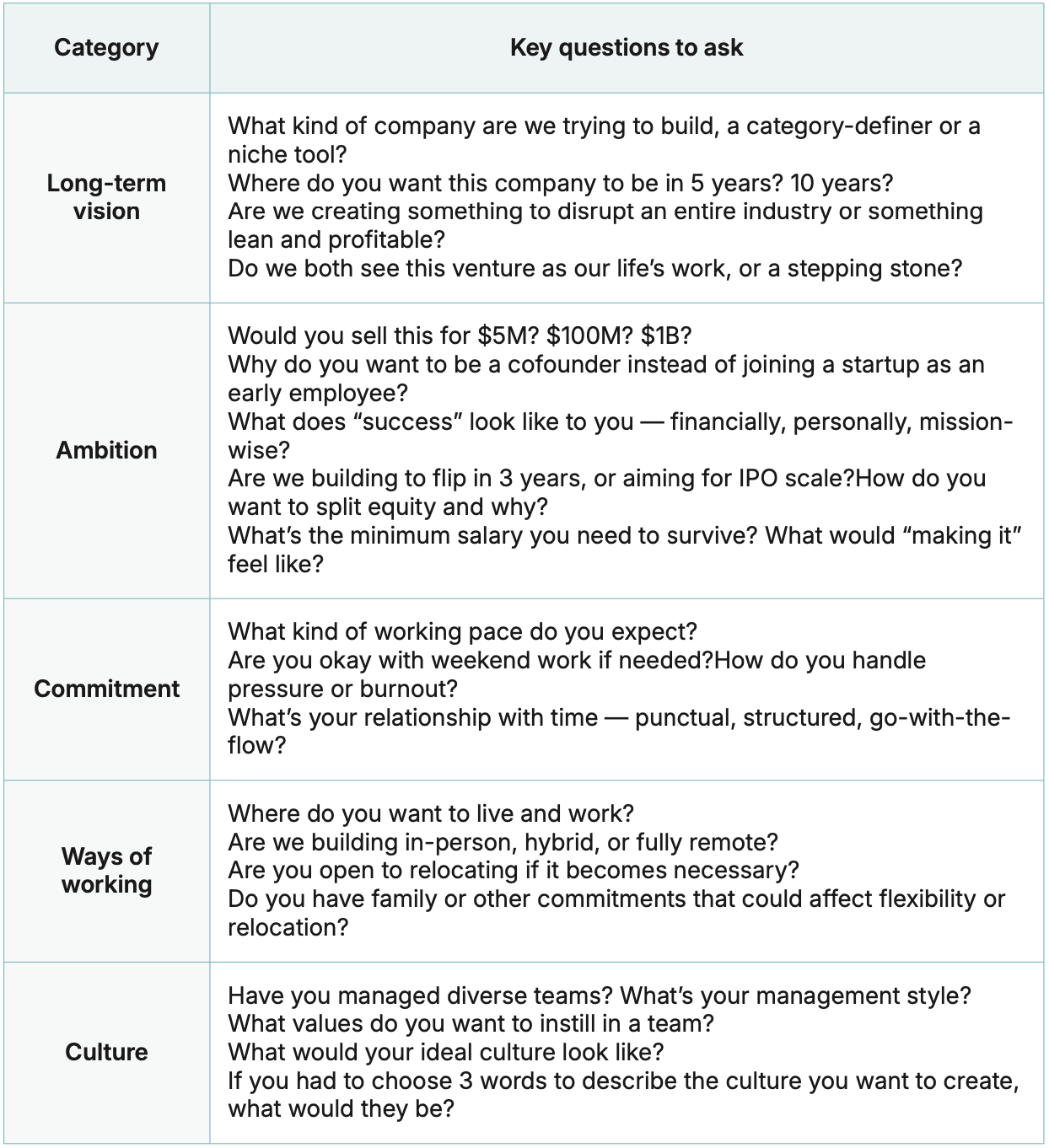
Aligning on values as cofounders is foundational as those early shared beliefs often shape the company culture.
“Value alignment is crucial, especially for making it through the long haul and the tough moments. In our case, it showed clearly: the values we shared as cofounders naturally became the company’s values: having a long-term mindset, excellence, and being human.”
– Nicolas Saison, CPO and Cofounder of Swan
Assessing transparency, trust & communication
Throughout the cofounder matching process, one thing that matters just as much as the assessment of complementarity and values is how you communicate.
Transparency is a core ingredient in any successful cofounder relationship. If you’re not able to speak openly with each other now, during the early stages, it’s unlikely that will magically change later when the stakes are higher and the pressure is on.
That’s why one of the best signals to look for early on, and that means during the assessment part, is how naturally transparency flows between you. Are you both willing to be open?
“I think the key step is to have an extremely open and honest conversation right from the start to align expectations: What is everyone’s ambition? Will we still be aligned three years from now? If someone wants to leave, what happens? It might feel a bit uncomfortable or overly formal at first, but it’s critical to tackle the difficult questions on day one. In my view, this is one of the healthiest practices you can adopt when starting a company.”
– Rodolphe Ardant, Cofounder of Spendesk
Insight from Amaury Sepulchre, Partner and Cofounder of Hexa
The best way to build trust early is to go first. Be the one to open up. Here’s how to lean into that:
Talk beyond the business.
Get personal. Share your aspirations, fears, and dreams.
What drives you beyond the startup?
What scares you about this journey?
Are there personal constraints (finances, family, health...) that might shape how you show up?
Be upfront about your weaknesses.
You’re not perfect and odds are your cofounder won’t be either. So don’t
be afraid of being vulnerable and talking about your weaknesses during the process, it will help your cofounder open up too and create a space of transparency.The earlier you establish a foundation of openness, the easier it becomes to navigate the inevitable hard conversations ahead.
Don’t rush the process
You need enough signal to feel confident this is someone you can build a company with. One great conversation isn’t enough. Before committing to something this high-stakes, it’s worth spending a lot of time with your potential co-founder, in lots of different contexts.
Have at least three conversations
Chemistry in a meeting is one thing, but trust is built across different contexts. We recommend at least three conversations before making any kind of decision, ideally including one informal one (a walk, a coffee, a dinner). Three is the bare minimum - ideally, you’d have more. It helps you both drop the pitch and just talk like people.
Work together for a week
You’ll learn more from spending a week building together than from any number of conversations. Once you’ve had a few chats and things feel promising, this is often the phase where the rest of your questions get answered.
We usually recommend founders run a short POC together. You might spend that time mapping out what the product could be, exploring different directions, and talking to a few design partners. The output doesn’t matter as much as the process - how ideas evolve, how you handle ambiguity, and whether it feels like progress.
A week is usually enough to get a meaningful sense of the dynamic. If you’re still unsure after two, it’s probably worth pausing to reflect on why.
Get a second opinion
Ask someone you trust to give you an outside perspective, ideally someone
in the same domain as them. If it’s a technical profile, a friendly CTO might be willing to review their GitHub, or talk to them for half an hour to assess their technical skills. If it’s a business profile, ask a CEO or business lead to skim your notes about them, or ask if they’d mind having a quick phone call. Especially if they’re in your existing network, most people are usually happy to help!
Run references
A very important part of the process that should never be skipped. We recommend speaking to two managers and two people they’ve managed. And it should go both ways, invite them to do the same for you. You’re both making a serious bet, and references help you make it wisely.
Common founder mistakes
We’ve experienced a lot of founder matching processes at Hexa, and some of the same thinking traps show up again and again when people are choosing a cofounder.
Here are the four we see most often:
“We need to click instantly”: The first meeting is just the first step. If it feels a bit clunky, that’s normal - you’re still figuring each other out.
“We should be best friends”: You don’t need to be soulmates. You do need to enjoy working together, but it’s not about sharing secrets on a five-hour walk.
“I need to find someone like me”: This one’s sneaky as it often happens without realising. But sameness leads to blind spots and overlap, not balance.
“The more impressive the CV, the better”: Shiny résumés can be distracting. Grit, adaptability, and follow-through are harder to spot, but far more important.
Keep these in mind when evaluating potential partners. They come up more often than you’d think, and they usually point you in the wrong direction.
How to make it work
Define roles clearly
One of the most common reasons cofounders fall out is a lack of clarity about who’s driving what. You need to clearly define roles and ensure everyone is comfortable with their titles - whether CEO, COO, CPO, CTO, or others. This means making sure you’re aligned on:
Who owns what (Product, GTM, Fundraising, Hiring, etc.)
Who has final say in each area (and how you’ll make cross-cutting decisions)
Tip: Use a skills × passion matrix.
To figure out who should own what, list out all the key areas of the company. Then for each one, ask:
Who’s strongest at this?
Who’s most energised/passionate by this?
When assigning ownership, consider how the work energizes each person instead of relying solely on job titles or previous roles.
Splitting equity
There’s no one-size-fits-all when it comes to equity splits. Interestingly, when you look at SaaS companies at the IPO stage, most founding teams didn’t split equity equally.
This doesn’t mean unequal splits are always the right move, but it does suggest they can work under the right conditions. It also highlights that success depends on a range of factors.
That said, in our experience, when cofounders join at the same time and are equally committed, equal splits tend to work better. They reinforce mutual accountability and signal equal weight in shaping the company’s future. Unequal splits, on the other hand, can introduce subtle power dynamics, one founder may start to feel like an early hire rather than a true partner. Over time, that can erode trust, alignment, and motivation.
So if you can make equal work, we recommend doing it.
Bring in a cofounder coach early
Most founders wait until there’s already tension, but the best time to bring in a coach is when things seem to be going fine. That’s when you’re more open, less defensive, and most likely to build habits that stick.
A coach is there to help you talk about the things that are easy to ignore: how you make decisions, how you handle stress, what starts to build resentment when it’s not named.
They’ll help you spot the patterns early before they turn into problems. And more than anything, they create a space where you can be honest with each other, without it feeling personal.
Think of it like getting a trainer when you’re healthy, not after the injury. Prevention is the point.
Set up rituals
Rituals aren’t mandatory, but they’re something we actively encourage at Hexa. They help catch small misalignments before they grow and keep communication intentional.
That said, not every founder pair needs them. If you’ve already worked together for years, or if you’re side-by-side every day, those moments of sync might happen naturally.
Take Nicolas Benady, CEO & cofounder, and Nicolas Saison, CPO and cofounder, at Swan: they’ve known each other for 21 years and sit next to each other every day. Communication has become second nature, so a scheduled check-in doesn’t add much value. But for most cofounder pairs rituals can make a real difference.
“We don’t have any formal rituals. We sit next to each other every day and talk all the time. We don’t even have scheduled one-on-ones. The day we don’t talk, my hand starts shaking, I just don’t feel right. From my point of view, over-ritualizing kills a bit of the magic. Especially for something long-term.”
– Nicolas Saison, CPO and Cofounder of Swan
Insight from Matthieu Vaxelaire, Partner at Hexa
A consistent weekly check-in can go a long way in the early days of a cofounder relationship. So can short retros after a big push, or async updates when you’re both moving fast in parallel. What matters is having regular, intentional moments to check in with each other.
One habit that has worked for many Hexa founders: a simple weekly self-assessment. Once a week, each cofounder shares:
What went well this week
What could’ve gone better
One thing they’d like feedback on
What keeps them up at night
It might feel a little formal at first, but over time, it builds a habit of alignment, which is what keeps relationships healthy under pressure.
Realign on values - not just once
Alignment on values isn’t a one-and-done conversation. It’s not enough to have a deep discussion during the cofounder “dating” phase and then assume you’re good for the rest of the journey. Priorities shift and what felt aligned six months ago may need revisiting today.
That’s why great founding teams treat value alignment as a recurring practice. They revisit the five non-negotiables — ambition, vision, commitment, ways of working, and cultural values — regularly, especially during key inflection points: fundraising, hiring, pivots, or even personal life changes.
“You have to revisit that alignment regularly, it’s not just a one-time discussion, Realign on ambition and vision, ideally quarterly. Maybe twice a year is enough for some, but having a regular cadence helps surface any change in direction before it becomes a problem. Having that level of clarity avoids a lot of unnecessary tension.”
– Jordane Giuly, Cofounder of Spendesk
Some founders go as far as setting a dedicated quarterly check-in, just to talk about alignment. Because in a cofounder relationship, misalignment doesn’t happen overnight. It creeps in slowly, silently, until one day you realize you’re running in different directions. Regular realignment keeps that from happening.