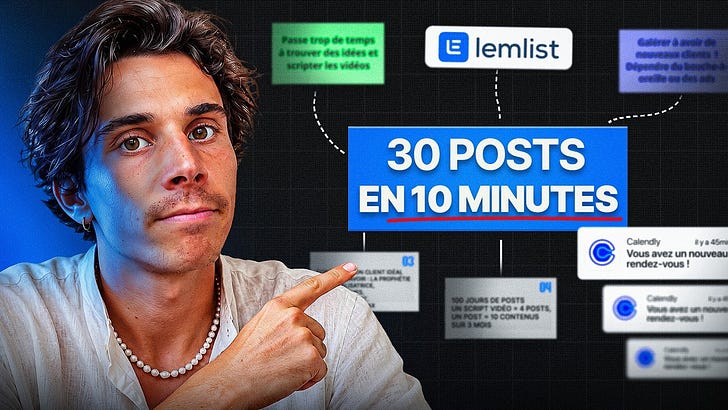
In 2018, Guillaume Moubeche had €1,000 in share capital, no network and no money for ads. Today lemlist, the sales prospecting platform he founded, is used in more than 100 countries and, by his account, generates over 60 million in annual recurring revenue. Much of that growth started with posts, videos and podcasts he produced himself.
The room was full of early-stage founders, many of them, like Florent, self-declared introverts. The brief for the evening was to leave them with enough concrete advice to go home and film themselves talking about their company.
In short, Guillaume’s playbook for founder-led distribution:
Document what you do instead of wondering what to post.
Content builds trust, and trust is what customers pay for.
Write for one specific customer about one specific problem.
Judge a post by the meetings it books, not the likes it gets.
Recycle relentlessly: one script can become ten pieces of content.
Give it 100 days before deciding whether it works.
How lemlist grew with no budget and no audience
With nothing to spend on ads, Guillaume had two levers: use his own prospecting tool to send emails, and write. He never asked himself what content to make. He simply documented what he was doing to launch the business, borrowing from the US build-in-public movement led by people like Noah Kagan and Pieter Levels.
Being lemlist’s first user made that easy. Using the product every day exposed its flaws. And when it delivered results, those results became the content, showing customers what they could achieve too. A Facebook group he started grew to 20,000–30,000 sales professionals. Their questions told him what people didn’t understand, which improved both the product and the next post.
He is careful not to oversell content, though. lemlist’s first 100 customers came in roughly a year, all through outbound, including cold calls to the US with a French accent. Until the company passed 10 million in ARR, around 80% of its customers were in the US, a market where he started with no network at all. “Team introvert” or “team extrovert”, his verdict is the same: a founder needs both.
Why founder content builds trust: the Marco Polo test
Guillaume put a question to the room: why is Marco Polo famous? Thousands of Venetian merchants travelled the Silk Road before him. He is remembered because he wrote about it.
Founders are in the same position. After years inside a problem, what you know starts to feel obvious. It isn’t, and explaining it is how you earn trust. That matters because, in his words, customers pay you because they trust you to solve their problem. He sees trust as a triangle that collapses if one side gives way:
Emotional connection: whether people like how you come across.
Reliability: whether your promises hold. Overpromise once and it is gone.
Credibility: who you are. Content builds it, because every post is a window into how you think. So does association, which is why early podcast appearances pay off.
What should founders post about?
Start from the customer, not the product. Guillaume’s method: picture your ideal buyer, say CAC 40 CEOs. List the urgent problems you can solve for them, break each into sub-problems, and write about those. “I spoke with two CAC 40 executives this week; here are three things I learned” is the kind of post today’s algorithms put in front of exactly the right readers.
His new investment business shows it works. His partner spent ten years structuring deals at UBS. Content built on her experience with wealthy families now brings some of the wealthiest families in France and Switzerland to her inbox.
The takeaway for B2B founders: “boring” markets are often the best opportunity. AI has made generic content cheap, so niche and specific is what still stands out. As a rule of thumb, around 80% of your posts should solve your audience’s problems and 20% can talk about your product.
Should you pick a fight?
Guillaume’s breakthrough was a series called Cold Email Tips. Most prospecting advice online, he noticed, came from marketers writing for algorithms rather than people who had ever done outreach. He took the opposite side, named the opponent and argued his case. The debate created traction, and five years of focus on one problem made his name in sales.
But an enemy only works if you can back it up. Attack a bigger competitor with a weaker product and you lose credibility fast. The same applies to tone. Early lemlist was all emojis and “Hey Listers” videos, which built a loyal community. Then, whenever the product had a bug, the jokes made users angrier. Humour is welcome; it just shouldn’t be the whole brand.
How to tell if your content is working
Florent observed that selfie posts seem to outperform posts that teach something. Guillaume questioned the premise. A post works, for him, when it books meetings with qualified customers. Fifteen likes and three messages from CEOs at the right companies beats a viral selfie.
This matters most in industries full of lurkers, people who read everything and never react. Finance is one. They won’t like your post, but if it speaks to their exact problem, they will write to you. His favourite format follows the same logic: share four genuinely useful tips and make the product the fourth, as the way to save time.
One script, ten pieces of content
On a trip to the US, a partner’s CMO caught Guillaume about to film improvised videos and sat him down to write scripts instead. The next day he noticed two things. An hour of scripted filming produced a stack of videos. And each script was worth about four LinkedIn posts, which could become posts on X, a newsletter and more.
The lesson: recycle without guilt. New followers never saw what worked two months ago, and those who did will likely engage again. Channels matter too. Videos he reposted to YouTube converted far better than on LinkedIn, because people searching YouTube to learn something are close to buying.
At the start, he insists, the founder should do this work personally. Writing forces you to state your pitch in one line. Editing your own videos exposes every verbal tic. Both make you better on sales calls.
The podcast staircase
Guillaume prospected for podcast slots as hard as for customers, and estimates he did around 500 in his first two or three years. Start with small shows of 50 to 100 listeners, bring good stories about your market, then use each episode as proof when pitching a slightly bigger one. Hosts can rarely tell in advance who will be a good guest. A young founder with energy and real stories is a safer bet than a tired executive on a press tour. He now hosts his own show, Billions, so he knows both sides.
How long until founder content pays off?
“Your first post will be bad. Mine was. So were the tenth and the twentieth.” Guillaume’s answer is the rule of 100: do it every day for 100 days, ignore the likes, and study why posts don’t land. Count on about an hour a day. It gets faster; he now drafts 20 to 30 posts in an hour.
The timing has rarely been better for newcomers. TikTok ended the era when platforms favoured established creators, and every network has since followed. That gives founders instant, free market feedback on anything they test. Asking friends to like your posts, on the other hand, counts for less than it used to: algorithms spot it, and likes from outside your field can confuse them about who your post is for.
Can AI write your LinkedIn posts?
It can help, Guillaume says, but it gives posts only the illusion of being well written. The angle, the relevance and the hook are still on you.
AI is excellent at ideation. Ask it for the 15 biggest problems facing CMOs at large adtech companies and you have a list to dig into. Feed it your best and worst posts, ask why each one performed as it did, and keep those conversations. The hard part is knowing what good looks like. If you have never written, anything AI produces will look better than your own drafts, and that is how average content gets published. You are still the captain.
One more tip: AI phrasing is now easy to spot, and readers scroll past it. What stands out today is a raw, unformatted block of real thinking. Marketers call it a pattern interrupt. When everyone does the same thing, do something else.
You don’t need permission to build an audience
Asked who inspires him, Guillaume named David Senra of the Founders podcast. With no network and no guests, Senra built an audience by summarising biographies of great entrepreneurs. Once it was big enough, the guests came to him.
That was the thread running through the evening. You don’t need an audience before you start, or the playbook everyone recommends. You need a problem you understand better than almost anyone, and the patience to be bad at explaining it for a while. Few founders make it past their first hundred posts. That alone is an advantage.
Thanks to Guillaume for his time and candour, to our production partner Pilea Agency, and to everyone who joined us. Storytime by Hexa brings experienced founders to our Paris office for honest conversations with early-stage founders. Follow Hexa on Luma to hear about the next one.