


Salesforce stock dropped 43% in 12 months. Meanwhile, Toast—the restaurant software company—posted its first year of GAAP profitability in 2024, with 80% of revenue now coming from embedded payments and lending. Mews, which makes hotel management software, processed $10 billion in payments last year and reached $2.5 billion in valuation.
If you’re building vertical SaaS, these data points should matter to you, because they represent a fundamental shift in how software creates value. For the last 15 years, the venture capital playbook has been clear: horizontal beats vertical, the biggest TAM wins.
That playbook is breaking down, and the vertical SaaS founders I work with at Hexa Scale are starting to see it in their own businesses.
I think we’re at an inflection point, and most vertical SaaS founders don’t realize how strong their position actually is. You’ve been told your market is too small, your niche is too specific, your business isn’t venture-scale. Meanwhile, Salesforce has launched twelve “Industry Clouds” trying to become a vertical solution for healthcare, education, manufacturing, and every other sector. They’re spending billions trying to build what you already have: deep domain expertise and workflows designed for a specific customer.
The numbers are showing up in retention rates, in revenue per customer, in the economics of customer acquisition. Vertical SaaS companies consistently show higher retention than horizontal platforms, and the best ones are now layering in embedded financial services that can significantly increase revenue per customer. AI is strengthening their moat while simultaneously eroding horizontal SaaS’s.
Indeed, the underdogs are winning.
Horizontal SaaS is running out of steam
Horizontal SaaS has been the obvious startup bet for some time. CRM for everyone. Marketing automation for everyone. Project management for everyone. Build one product, sell it to every industry, achieve infinite scale - the pitch was elegant.
The model has started showing its limitations. HubSpot grew revenue by 18% in 2025, which sounds good until you realize that revenue per customer only grew by 3%. They’re adding customers, but those customers aren’t getting more valuable. The growth is coming from volume, not depth, and volume is an expensive game when your customer acquisition costs keep climbing.
The Salesforce story is even more revealing. They’ve now launched twelve “Industry Clouds”—for healthcare, education, financial services, nonprofits, manufacturing, government, retail, and on. Each one is essentially an admission that horizontal software doesn’t actually work horizontally. What they’re building now are vertical solutions bolted onto a horizontal platform, except the platform was never designed for this. It’s become a kind of digital Frankenstein, extended by armies of consultants who use it as a blank canvas because the out-of-the-box version doesn’t do what anyone actually needs.
For every dollar Salesforce makes, their partners make $6.19—the consulting ecosystem is five times larger than the product itself. Ninety percent of implementations require custom development, users only utilize half the available features, and 42% still store critical data in spreadsheets. Forrester reports that 70% of implementations fail to meet their stated objectives.
This is what happens when you try to make one tool serve every possible use case. You end up with something so general that it’s useful to almost no one without significant customization, and customization at enterprise scale costs a fortune.
Of course, horizontal SaaS isn’t going to collapse overnight. Enterprise software moves slowly, switching costs are brutal, and most large companies haven’t even finished moving off on-premise systems yet.
But new market entrants aren’t choosing these platforms the way they used to. Small and mid-sized businesses are adopting faster, and they’re increasingly choosing tools that were built specifically for them rather than tools that were built for everyone and no one.
Domain expertise = the real moat
While horizontal SaaS companies were raising massive rounds and chasing infinite TAMs, vertical SaaS founders were building something different. Software for labs. Higher ed administration systems. Tools for small construction firms, hotels, dental practices. The markets looked small—$50 million to $500 million addressable, not the $10 billion-plus that VCs wanted to see. The industries felt unsexy. The founders were often industry insiders, not product people from Google or Facebook, which meant the early versions had dated UX and clunky interfaces that looked “old school” compared to the polished horizontal tools.
VCs passed. Growth investors passed. The conventional wisdom was that these businesses would never scale, and the founders would never get the outcomes they deserved.
Meanwhile, these companies were building something that horizontal platforms couldn’t replicate. They understood the workflow at a level that no general-purpose tool could match. A dental practice management system built by someone who’s run a dental practice knows things that Salesforce will never know—how insurance verification actually works, how to handle operatory scheduling conflicts, how to manage the specific compliance requirements for patient records.
The retention numbers reflect this. Vertical SaaS companies see 35-60% higher retention than horizontal platforms because the software actually solves the problem it was designed to solve, without requiring an army of consultants to make it work. The CAC is lower because word spreads through industry networks—trade shows, professional associations, peer recommendations.
Many of these companies were bootstrapped or grew with minimal outside capital, which meant the founders kept control and built sustainable unit economics from day one. There were no insane burn rates, no growth-at-all-costs mandates from a board that needed a 10x return in five years.
3 forces accelerating the shift to Vertical
The landscape has recently shifted in three ways that particularly benefit vertical SaaS, and understanding these shifts is critical if you want to capitalize on this moment.
1. AI can’t replace knowing what to build
AI is very good at solving general problems. This is bad news for horizontal SaaS, because horizontal SaaS solves general problems. If your value proposition is “we’re a CRM for everyone,” and AI can help a company build a lightweight custom CRM in a few weeks, your moat disappears quickly.
Vertical SaaS has a natural defense against this: deep domain expertise. AI can help someone build a generic task management system, it can tell you what high-level workflows a hospital lab needs for specimen tracking, but not at the level of field experience, that gives you all the small details and edge cases that make a good product good. That knowledge still has to come from somewhere, and “somewhere” is either years of industry experience or a product that was built by people who have that experience.
Software creation costs are decreasing, which means the value is shifting to knowing what to build. Product design informed by deep domain knowledge becomes the differentiator, not the ability to write code. If you’re a vertical SaaS founder, this is working in your favor.
2. Fintech can 3-5x Vertical’s Revenue Per Customer
Traditional SaaS charges subscription fees: $50, $100, $500 per user per month. But that model is getting commoditized, and AI is accelerating the compression. It’s getting harder to charge meaningful subscription fees for software alone.
Meanwhile, fintech has become embeddable. Payments, lending, insurance, bank accounts—all of it can now be built directly into your product. And if you’re vertical SaaS, you’re already sitting in the middle of the financial workflow. Restaurant software sees every transaction, hotel software processes every booking, legal practice software handles every client payment.
Toast already makes 80% of its revenue from financial services, not software subscriptions. They lend $1,000 to $300,000 to restaurants through Toast Capital, underwritten on the transaction data flowing through their system. That lending business helped them reach GAAP profitability in 2024 after years of losses.
Mews processed $19.7 billion in payments in 2025 —double the prior year— and their valuation jumped from $1.2 billion to $2.5 billion. Clio, the legal practice management platform, is now over $300 million in ARR with billions processed annually through Clio Payments.
Stripe reports that 60% of all small businesses in America use a vertical SaaS platform, and over 15,000 vertical SaaS companies have embedded Stripe payments. The reason is simple: adding fintech can increase revenue per customer by 2-5x, and the unit economics are often better than subscriptions. You’re taking a small percentage of large transaction volumes instead of charging a fixed monthly fee.
If you’re a vertical SaaS founder and you haven’t thought seriously about embedded fintech, this should be a top strategic priority. It’s a completely different business model that compounds the advantages you already have.
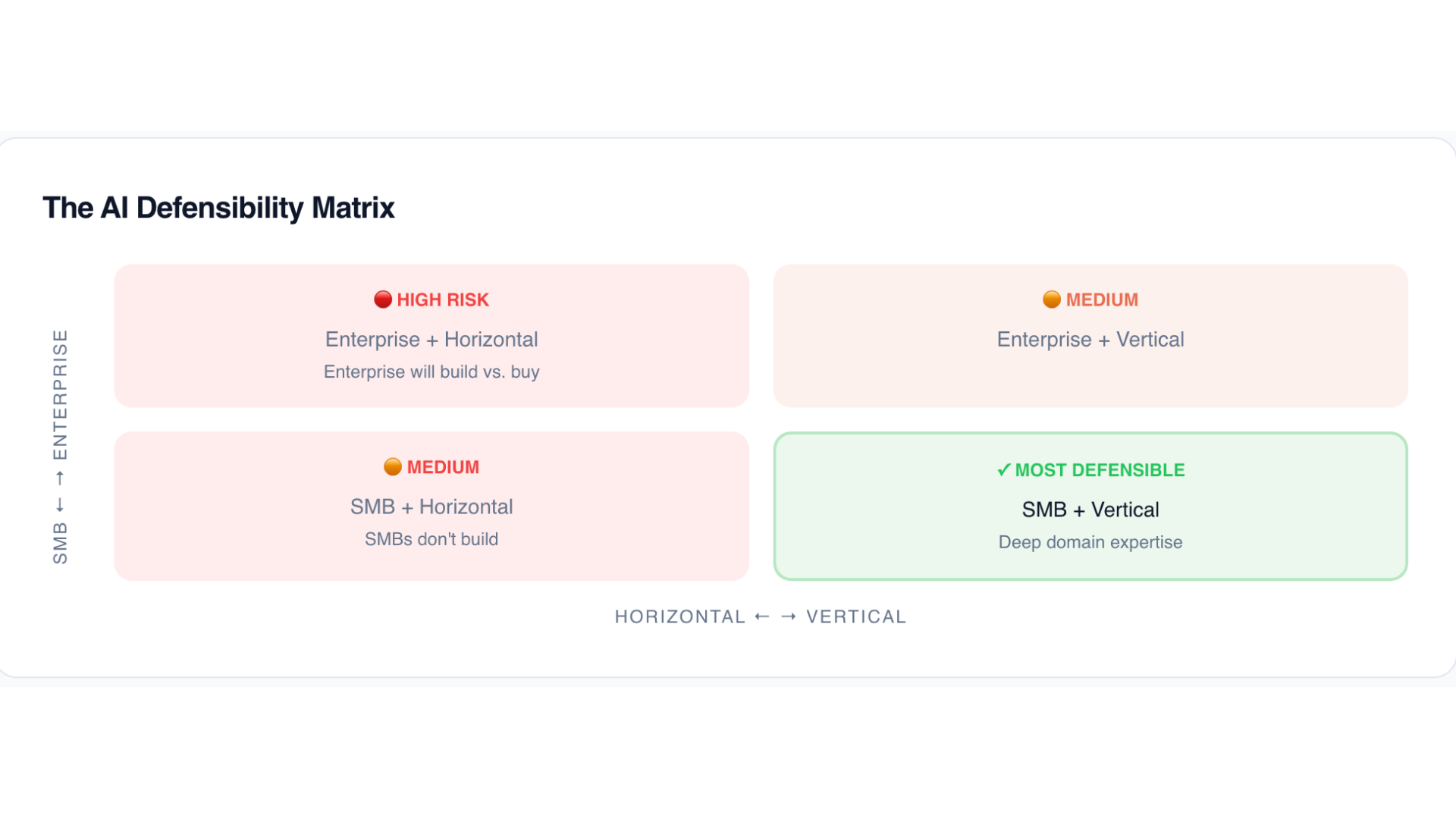
3. Your customers will buy, not build
Your customers are not going to build their own software, even as AI makes it easier to do so.
Restaurants, schools, museums, labs, and dental practices are businesses at the end of the digitalization curve. We’re still talking about software adoption, about replacing pen-and-paper processes or on-premises legacy tools with digital workflows. These customers don’t have internal tech teams. It’s not their job to code, and even with AI lowering the barrier to software creation, they’re not going to start.
This is different from the enterprise customers that horizontal SaaS serves. Large companies have engineering teams that can evaluate build-versus-buy decisions. When AI makes it easier to build custom internal tools, those companies will increasingly choose to build. But your customers—the restaurant owner, the dental practice manager, the hotel operator—they just want a tool that works. They will buy, not build.
This is a structural advantage that’s easy to underestimate. The threat that AI poses to horizontal SaaS—that customers will build their own solutions—doesn’t apply to you in the same way. Your market is more defensible than it looks.
Result: the markets that were ‘too small’ are now worth billions
Horizontal SaaS had its moment. The winners were built in an era when being general-purpose was an advantage, when the path to scale was clear, and when venture capital rewarded growth above all else. That era is ending because the conditions that made it dominant are shifting.
The next wave of valuable software companies will be vertical SaaS businesses that combine deep domain expertise, embedded financial services, and AI-enhanced product development. These companies will have better unit economics, higher retention, and more defensible moats than the horizontal platforms that preceded them. Many of them already exist—they’ve been the underdogs for years, quietly building sustainable businesses in markets that VCs didn’t think were big enough.
If you’re one of those founders, the question isn’t whether the landscape has shifted in your favor. It has. The question is whether you’re positioned to capitalize on it. Are you thinking about fintech as a core part of your business model, or just as a nice-to-have feature? Are you using AI to accelerate your product development in ways that your competitors can’t match? Are you articulating the value of your domain expertise in a way that makes it clear why you’re not just another SaaS company, but the definitive solution for your industry?
The markets that nobody wanted 10—even 3—years ago are now worth billions.
And most importantly, vertical SaaS is the best place to build AI agents solving real-life-problems for the whole SMB economy. I’ll cover that in a second article.
Now is the hour of the underdogs. Make sure you don’t let it pass you by.

100 % in agreement