


We’re publishing a new chapter of The 10x Method every week, our sold-out book detailing Hexa’s early-stage methodology that built 50+ companies, 3 of which are unicorns. You can unsubscribe from future drops here.

Founders often assume that structured hiring and people practices, like using scorecards in interviews, running regular 1:1s, or giving formal feedback, can wait. The belief is that those things are for later, once you’ve scaled. The truth is, hiring and retaining talent at the earliest stage isn’t fundamentally different from doing it at later stages. But it matters more. When you have a team of one or two, every person carries outsized weight. Hiring the right people, and keeping them, requires just as much structure as it does at 50 or 500 people.
This is one of the most critical chapters in the book. Early hires shape everything. We’ve seen it again and again: get them right, and you build a strong foundation. Get them wrong, and the risks are massive. Without the right early team, your product will suffer. You’ll struggle to acquire customers. Your brand won’t take shape. Your metrics will lag. Everything downstream depends on getting this part right.
The first people are setting the standard. At Spendesk, it was early interns who coined the phrase “ship, ship, ship,” capturing the company’s bias for action and fast execution. When those early hires moved on years later, some of that unique energy left with them.
At Swan, the first 20 hires are still with the company. They carry deep institutional knowledge and continue to reinforce the culture that made the business successful in the first place.
Early employees hire the next generation. That’s why the bar needs to be high from the very beginning.
In this chapter, we’ll show you how to find, attract, and retain the right early hire. From identifying who to bring on board first, to running a great hiring process, to building the kind of team culture that keeps top talent engaged and growing with you.
Who to hire
Time well spent
As a founder, hiring is one of the most critical responsibilities you will take on. It is not something you can delegate in the early days and so understanding the process firsthand is essential. You should be prepared to spend 30–40% of your time on recruiting and HR-related tasks in the early stages.
“Consider the first 10 people you hire with the same level of rigor as you would for a cofounder. Some first employees can eventually become late- stage cofounders, their impact can be just as crucial.”
– Quentin Nickmans, Cofounder and Partner at Hexa
“A company isn’t built by founders alone, it’s built by the entire team. But it can be undone by the founders alone... That’s why your early hires are so important: they set the tone for the culture, the ambition, and the way your company thinks as it scales.”
– Evan Testa, CEO and cofounder of Roundtable
The only way to learn is by doing. Before hiring someone to handle a function, you need to immerse yourself in it. This applies to coding, sales, product, and most importantly, recruiting. Sourcing, reaching out to candidates, and running interviews should be part of your initial efforts. Sending LinkedIn messages, following up, and refining your pitch will teach you what works and what doesn’t. Just like hiring a salesperson without having spoken to customers yourself makes little sense, hiring a recruiter too early disconnects you from a fundamental process.
That said, you don’t have to do everything entirely alone. It introduces too many biases and you end up making poorer decisions. While hiring a full-time recruiter as one of your first employees is unnecessary, you can leverage external support. Engaging a freelancer, a recruitment agency, or an RPO (recruitment process outsourcing) consultant can help you source and generate leads. However, this only works if you already understand the basics of hiring, otherwise, you risk relying on a system you don’t control.
Engineers
Your first 1 to 3 hires should be engineers, ideally full-stack. What’s most important is flexibility: even if they’re primarily backend or frontend, they must be willing to work across the stack. In the early days, your product will evolve quickly, and you’ll need people ready to adapt. Hiring someone too specialized, and unwilling to step outside their core expertise, can box you in before you’ve even figured out exactly what you’re building.
As discussed in the chapter on cofounders, the technical founder must be hands-on, not just managing, but actively coding. During those early months, this is non-negotiable. At this stage, you’re not building a tech organization, you’re building the product.
A frequent challenge we’ve seen? Founders moving quickly to hire freelancers. It can seem like the fastest path forward, you have a clear idea of what you want to build, and you’re eager to ship. But that early speed can lead to setbacks.
It’s important not to outsource your first build. This is the most critical phase of product development, and it needs to be done by people who are committed to the long-term success of the company. Freelancers won’t lay the groundwork for scale. They won’t set up clean architecture, strong processes, or thoughtful systems.
The only time we recommend working with freelancers is for very specific, tightly scoped tasks, for example, coding a specific part of the product. But you should never rely on freelancers to lead or drive major projects during this phase. And they should never replace a hire you will eventually make.
Coding is also strategy. And that’s why the technical founder should be in the trenches, working side-by-side with the first hires. That’s how you build a strong foundation, and bake long-term vision into the code from day one.
Yes, hiring great engineers takes time. But not as much time as you think. Especially if you follow the steps outlined in this chapter.
“One thing that’s been key is involving engineers deeply in the product. Product scopes and defines the goals, but engineers co-design the solution with them. That tight collaboration has been part of our DNA from day one. It’s also what helps attract truly valuable founding engineers: the kind of builders who don’t just want to execute, but want to be part of the creation phase, shaping the product from the ground up.”
– Titouan Benoit, CTO and Cofounder of Dotfile
Insight from Paul Vidal, CTO and Cofounder of Collective
Pragmatism is key. Early on, you need someone who’s willing to get their hands dirty, ship fast, and make mistakes, not someone obsessed with perfect code.
If your first engineers are too precious about code quality, it will slow the company down. It’s not that meticulous engineers are bad, but they’re not the right fit for the first two or three hires. You need builders, not perfectionists.
To assess pragmatism, I designed a technical test that was intentionally very hard, almost impossible to fully complete within the time limit. The goal wasn’t for candidates to finish it but to force them to make trade-offs.
A good candidate would realize they couldn’t implement everything and would make smart decisions to deliver a working solution with the limited time available. That’s pragmatism: prioritize, focus, and ship.
I also made the test tough enough to create a broader range of scores. In earlier, easier tests, everyone scored 8 or 9 out of 10, and it was hard to differentiate. In this new setup, I had candidates scoring 2, 4, or 9 out of 10 — it became much clearer who stood out.
The founder associate
Your first business hire should be a founder associate, a highly versatile, execution-oriented generalist who can plug into whatever the company needs most. In the early days, that could mean supporting customer calls, launching growth experiments, or building out investor materials. Think of this person as your right hand.
Range matters more than specialization at this stage. You need someone with broad skills, and even more importantly, the ability to quickly adapt, because priorities and scope will inevitably shift as the business evolves. Over time, one functional area like growth, account management, customer success, or marketing will naturally start to take precedence based on the company’s needs and their individual strengths.
This role becomes even more critical during fundraising. When founders are out meeting investors, someone has to keep the machine running. A great founder associate can step in as a chief of staff, prepping materials, managing the process, and ensuring continuity so nothing breaks while the founders are focused elsewhere.
Founders often underestimate just how stretched they’ll be once the company starts gaining momentum. A founder associate helps extend your capacity. They’re not there to “own” departments, but to push forward projects, uncover problems early, and make sure critical tasks don’t fall through the cracks.
“Once we had landed two or three clients, we realized we needed someone to help drive and support the business side more consistently. So, we hired a highly versatile profile, someone capable of handling a bit of everything: outbound sales, marketing content creation, direct sales conversations, and even product demos when needed.
For a long time, we operated with this highly versatile profile, because at that stage, the business was still fundamentally founder-led. It was only much later, once we had matured as a company, that we started hiring more specialized sales roles.There’s no definitive hand-off where a founder can fully step away from sales, it simply doesn’t happen. Even today, while the team handles certain segments successfully, I’m still actively selling: whether it’s entering new markets, expanding into new geographies, or building partnerships. As the company grows, sales remains a constant part of the founder’s role, just in different forms.”
– Vasco Alexandre, CEO and Cofounder of Dotfile
Don’t hire a product manager early on
In the early days, the product vision should live squarely with the founders. Great product managers naturally want to own the product roadmap and vision. If you hire one too early, they may start to behave like late-stage co-founders, leading to misalignment and friction. At this stage, that would be a mistake.
An alternative approach? If delivery is starting to slip or you need help with coordination, bring on a part-time freelance product owner. Just make sure the strategic direction stays with the founding team, at least until you’ve hit product-market fit.
You should hire a product manager only when your product is showing real traction and scaling execution becomes difficult. By then, founders will often be overwhelmed with new priorities like operations, fundraising, and hiring. That’s when bringing on a PM makes sense: someone who can formalize processes, take ownership of execution, and keep product development moving forward.
“In B2B software startups, your first product manager should come as late as possible — ideally after you’ve found product–market fit, not before. Until then, the founder is the PM. PMF isn’t something you can outsource; it’s something you earn. It demands obsession: talking to customers, shipping fast, watching how people react, and adjusting constantly. Bringing in a PM too early creates distance right when you need to be closest to the problem. It slows down the rapid learning loops that are essential at this stage. You don’t hire a PM because you’re unsure what to build — you hire one when you can no longer keep up with the demand.”
– Mehdi Boudoukhane, CEO and Cofounder of Cycle
Stay flexible
Some startups will need to make specialized hires earlier than others. The specifics will depend on your business.
For example, Roundtable, where legal complexity is central to the product, hired a Head of Legal very early, along with operations staff as part of the first few employees. It was the only way to get the business off the ground.
The key is to know what’s truly essential for your company to move forward, and hire accordingly.
Hire for attitude AND for skills
You’ve probably heard the phrase: “Hire for attitude, train for skills.” And it holds true, but more in the later-stage of company building. In the early days, that only gets you halfway there.
For your first hires, you need attitude and skills. You simply won’t have the time or management layers to train people from scratch. Early team members need to hit the ground running. They should already know how to operate in fast-moving environments, solve problems independently, and contribute from day one.
What you need to look for:
Highly adaptable and curious. They’ll be wearing a lot of hats.
Deeply autonomous. They don’t need hand-holding or constant direction.
Entrepreneurial. Ideally, they’ve worked at a startup before or built something.
A common instinct when building your early team is to hire for your weaknesses, to fill the gaps. While that can make sense later, it’s not always the right first move. In the early days, what matters most is speed and execution.
“One of the least intuitive but most powerful moves you can make as a founder is to hire someone who shares your superpower. If you’re great at product, hire another strong product builder. It might feel counterintuitive, you’d think you should fill your gaps, but starting by doubling down on your strength makes delegation easy, hiring fast, and execution smooth. You’ll be able to transfer knowledge quickly, and free up your time without compromising quality. That time, you can then reinvest into tackling other areas, like sales or hiring, one by one. Only a founder has the grit to step out of their comfort zone and still give it everything they’ve got. By doing it themselves, they gain mastery over every aspect of the company. That’s how you grow your company: by reinforcing what you do best, then expanding deliberately.”
— Quentin Nickmans, Partner and Cofounder of Hexa
Insight from Mathilde Collin, cofounder of Front
Skills and mindset are equally important, even if the common wisdom sometimes leans more heavily on experience and hard skills.
For me, mindset is hugely important. And yes, in a very classic sense, things like having a growth mindset matter a lot. But I think what made our hiring approach more unique at Front was that we emphasized two specific values: low ego and high standards.
That combination is surprisingly rare. For example, in engineering, a low-ego mindset means being okay with shipping something that’s not perfect, just to get it in front of users quickly, instead of polishing endlessly. That’s the kind of attitude we were looking for.
One of the interview questions I liked to ask early on helped reveal this mind- set. I’d ask candidates, especially engineers:
“On a scale from 0 to 10: where 0 means you can’t code and 10 means you’ve reached your full potential as an engineer - where would you place yourself?”
Most of the people we were hiring back then were pretty young, so in my view, a confident and self-aware answer would be something like a 2 or 3. Because if you’re 22 and already think you’re a 9, that’s kind of limiting. Ideally, you believe you’ve still got room to grow, not just by 20%, but by multiples. And it takes both humility and confidence to say that in an interview.
That answer, when properly explained, often gave great insight into someone’s mindset.
How to hire
Active search
There’s no way around it: if you want to find great candidates, you can’t sit back and wait for them to show up, especially when your company is still young and unknown. You have to go on the hunt. You need to put in the work, scour LinkedIn, and actively convince exceptional people to join you.
Define a clear search strategy: Think about where to find the right people. If you need a frontend engineer, target companies known for exceptional UI design.
Try the “indirect ask” trick: We’ve seen this work time and time again. Instead of asking someone directly if they’re interested, ask: “Do you know anyone great for this role?” This lowers their guard, and sometimes sparks interest in the role themselves. And if someone you’ve asked directly says no to the role, ask them if they know someone who could be great for it.
Leverage your network: Your best hires may come from referrals, but it’s not enough to send one message and hope for a response. Always follow up at least twice. Many great candidates don’t respond immediately, and persis- tence is key.
Track your response rates: If fewer than 20–30% reply to your outreach, something’s off. Are you targeting people who are too senior? Is your message clear enough? It’s important to test different messages and people to refine and improve your response rate.
Outbound is a numbers game, but quality still matters: Don’t just spam LinkedIn. Tailor each message. Reference their work. Make it obvious you’re reaching out to them, not just “someone.
“What’s interesting is that even though we didn’t hire a lot of people directly through outbound, it still paid off. Most people we reached out to didn’t join, but they referred someone in their network. Outbound actually created a kind of network effect. When you start reaching out, people often respond with, ‘Hey, I’m not looking right now, but I know someone who is.’”That ripple effect really worked for us.”
– Evan Testa, CEO and Cofounder of Roundtable
Build a brand early-on
Inbound recruiting for a young startup is a long-term game, but one worth starting early because these efforts will compound faster than you think.
Start employer branding early: Even as a small startup, having a basic Notion career page with company values, images, and insights can make a big difference.
Leverage LinkedIn: Regular posts about your journey, team milestones, and open roles help create visibility and momentum. Top talent often follows founders, not companies.
Participate in events: Meetups, panels, and industry events are underrated for hiring. They build trust and help you connect with people who aren’t actively job-hunting, but might be open to the right opportunity. But be very selective about the ones you attend as they can become a significant timesink if you’re not too careful.
“Even when I wasn’t actively hiring, I made a habit of adding people on LinkedIn who looked like strong future candidates. It turned out to be incredibly valuable. When I eventually started recruiting for a PM role, many candidates already knew about Tengo from my posts. It made a real difference, the response rate was much higher.”
– Hugues Renou, CEO and Cofounder of Tengo
“I started posting on LinkedIn mainly for recruitment purposes. Finding great people, engineers especially, who share your mindset is very hard. By sharing thoughts, experiences, and opinions publicly, you naturally attract people who resonate with your way of thinking... It’s a kind of natural selection: people either connect with your energy or they don’t, and that’s exactly what you want in a startup team.”
– Paul Vidal, CTO and Cofounder of Collective
The job description
Most startup job descriptions are either too vague or too corporate. They either try to sound “cool” and end up confusing candidates, or they copy language from big companies that completely misses the early-stage reality. Neither works.
Your job description isn’t just a formality. It should excite the right candidates and filter out the wrong ones. Be clear about the mission, honest about the challenges, and specific about what success looks like. Make sure it also highlights the level of ownership early hires will have, because that’s what great early-stage candidates are looking for: real impact. Help them see it.
1. Title
Choose a job title that people actually search for, not just one that sounds attractive. For example, if you’re hiring a “Founding Engineer,” that’s fine as a title, but make sure to include terms like “Software Engineer” throughout your job description so candidates can find the role when searching those common keywords.
2. About the company
Remember, your company is new and unknown, so this section is crucial. Show what makes you unique and innovative.
Early hires join startups because they care about the “why.” Start with a punchy paragraph that explains what you’re building and why it matters.
It’s also a good place to emphasize how the first employees will play a huge role in shaping the company’s culture and impact.
3. What you’ll do (missions)
Forget the laundry list of responsibilities. Instead, describe the core problems they’ll own. Early hires don’t need every bullet point spelled out but they need to know what’s broken and what they’ll be trusted to fix.
→ “You’ll be responsible for developing and maintaining scalable front-end and back-end solutions.”Early employees’ job descriptions change rapidly. The role can be completely different six months after hiring compared to when they first start. When writing the job description, think ahead and clearly communicate how the responsibilities will evolve from day one through the first six months.
→ “This role starts as an individual contributor, but within 6–9 months, we expect you to help hire and mentor additional team members.”Adding a section “What success looks like in 6 months” is a great way to be forward looking
4. Technical stack (for certain roles)
List the technical stack for this role. This is common for engineering positions but should also be included for GTM, marketing, and operations roles. If you don’t have a technical stack defined yet and it will be the employee’s responsibility to create it, clearly state this in the description.
Be sure to include a line like, “Don’t hesitate to apply even if you’re not familiar with every tool in our stack” to encourage more diverse candidates to apply.
5. Who you are (requirements)
Founders often make the mistake of listing too many requirements compared to the mission section, which makes the job description look unbalanced. This happens because founders typically have a clearer idea of requirements - that’s the easy part.
Highlight just 3–5 traits or experiences that really matter
Clarify what’s nice-to-have vs. essential
The longer your requirements list, the less women will apply - so keep it short and impactful.
6. Why join (your company name)
Here’s where you list your company’s values and benefits. You might not have defined your values on paper yet, and that’s okay. No need to rush.
But you certainly have preferred ways of working. Are you async-first or meeting-based? Do you have monthly team lunches? Are there any special routines worth mentioning? This is your chance to let your culture shine, even if it’s still taking shape.
Beyond the classic perks like health insurance and company snacks, early-stage companies offer unique benefits where employees can make a real impact. Make sure to highlight these opportunities here.
7. Hiring timeline
It’s crucial to outline the hiring process steps clearly so candidates know exactly what to expect. At the early stage, you likely won’t have many team members, or any at all, so focus on creating a quick process with key stakeholders. Even as a solo founder or duo of founders, it’s essential for candidates to meet several people. If you don’t have a team yet, bring others into the process, this could be peers, fellow founders, investors, or freelancers helping with recruitment.
Initial call – A quick introduction with the CEO/other person
Technical Interview – A discussion with the CTO about your experience and skills.
Meet the team – A casual conversation with a current team member to ensure a cultural fit.
Reference Calls – Final step before the offer. We conduct at least two reference calls, one with a former colleague and one with a former manager. Additionally, we offer you the opportunity to speak with one or two people who have previously collaborated with us, so you can ask any questions you may have.
The first interview is about convincing
Founders often treat the first interview like it’s about evaluation. It’s not. The first call is about attraction.
Your job is to make the candidate want to join, especially with outbound candidates. But also with inbound ones. They might not be sold on your company as it’s still largely unknown and so you have to hook them.
At the end of an outbound call, flip the script: “Do you want to be part of this process?”
Let them opt in. If they’re in, great - now you switch into interview mode.
From there on, it’s about assessment. Use a scorecard. Define what “great” looks like. But never forget: if you don’t win them on the first call, you may never get the chance to assess them at all.
“The goal of the first conversation is not to grill the candidate with technical questions. It’s to make them leave thinking, “I really want to work with these people.” As a new startup with little name recognition, you must actively inspire candidates. It’s a selling call. Another tactic I used: after a great first call, I would immediately introduce the candidate to another co-founder for a second “selling” conversation. It wasn’t announced in advance, but it made candidates feel valued and gave them the impression that the company was moving fast and cared about them.”
– Paul Vidal, CTO and Cofounder of Collective
The importance of follow-ups
Throughout the process, maintain a strong connection with the candidate. Quick check-in calls between each interview stage are key. These calls, or even a simple WhatsApp loop, help you:
Keep the relationship warm - it helps show you care
Track whether they’re interviewing elsewhere - you don’t want to lose the candidate because they got an earlier offer somewhere else
Continuously gauge their motivation - it helps you know if they’re still en- gaged and interested in your company
Scorecards even at the start
Most founders aren’t experienced recruiters, and that’s completely normal. But it also means you’re especially vulnerable to bias. You might overvalue charisma, a shared background, or someone who just “feels right” in the moment. That’s why scorecards are so valuable at the early stage. It is a structured framework that helps you evaluate candidates based on clearly defined criteria, not just gut feeling.
A good scorecard also makes rejection easier. Instead of debating feelings, you have objective reasons to fall back on. It keeps the bar high and reduces the chance of bias creeping into your decisions.
Your scorecard should:
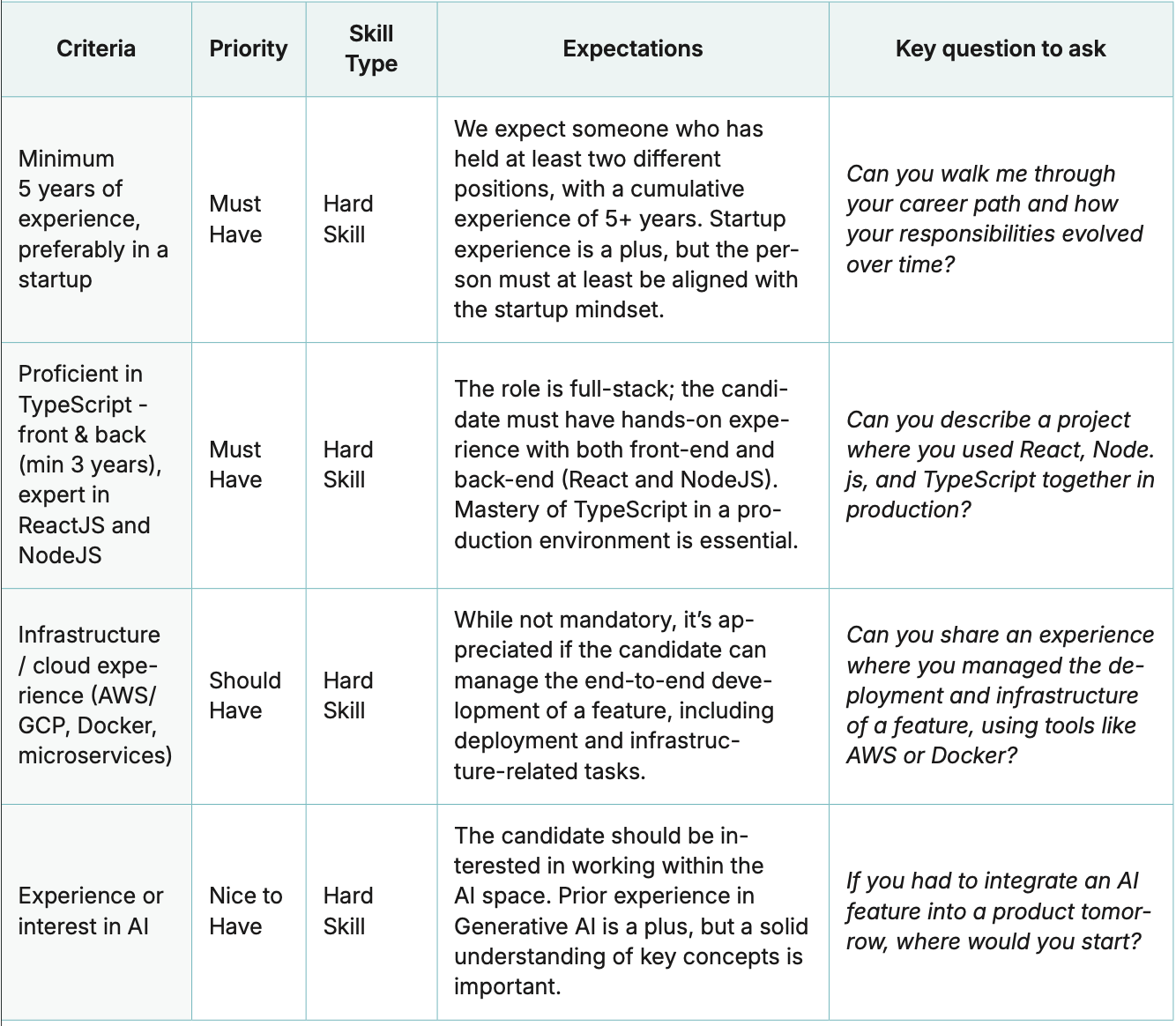
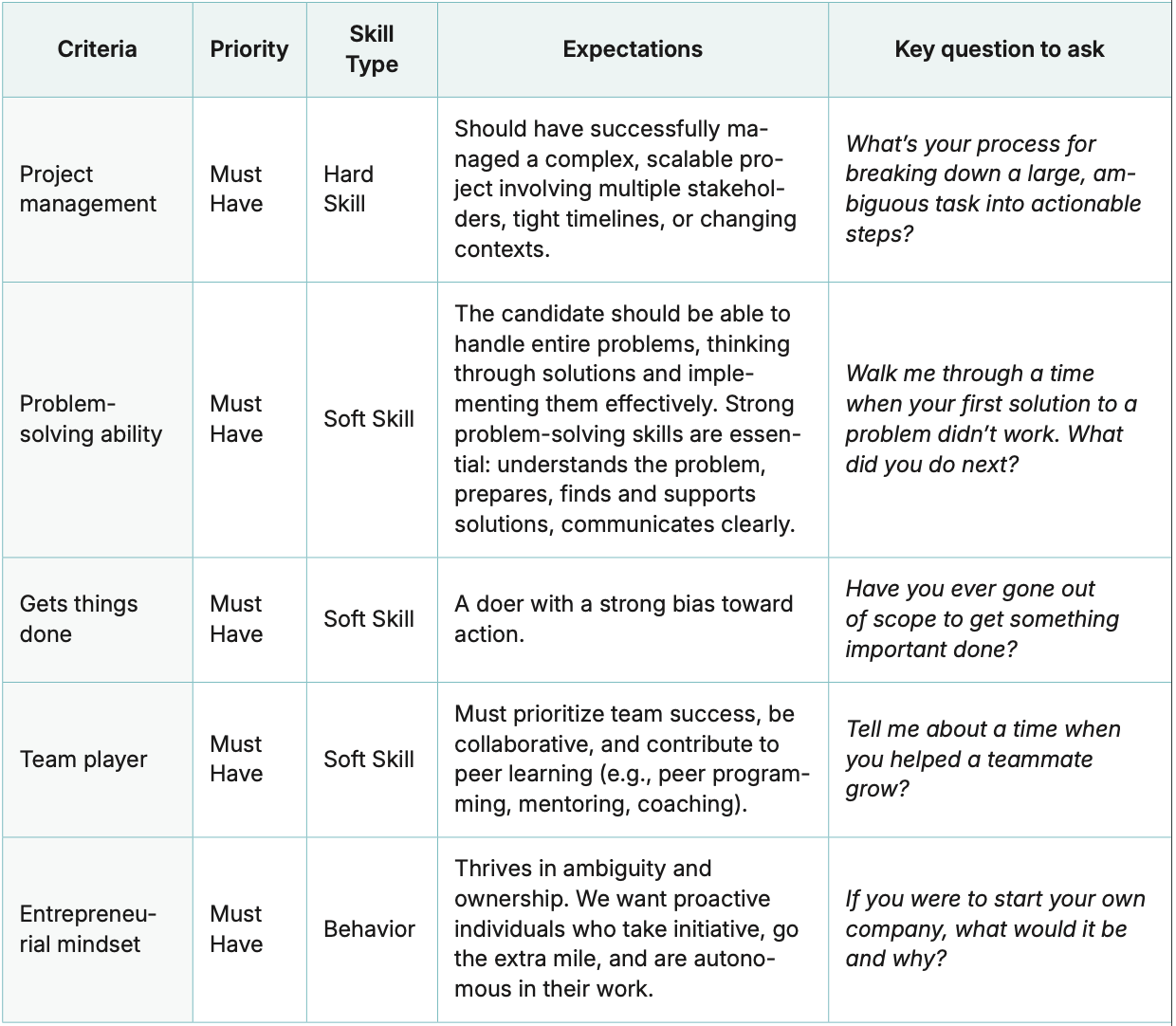
Categorize skills into must-have, should-have, and nice-to-have.
Include both hard skills (technical abilities) and soft skills (communication, problem-solving).
Limit criteria to a maximum of 12 - more than that makes the process too complex.
Each mission or responsibility in the role should be linked to a corresponding question on the scorecard. Always ask the same structured questions to every candidate. This eliminates random judgment and makes comparisons more reliable.
Here’s a scorecard template we’ve used for Founding Engineer positions:
Case study
Founders often ask us: “How do I evaluate someone in a role I don’t fully understand?” The answer is ideally, you should have done the job yourself first. Whether you’re a CTO who’s built the first version of the product, or a CEO who’s already closed the first sales, having hands-on experience is key. It gives you the context to know what good looks like and what to ask for when hiring.
That’s why the case study you assign should be based on something you’ve already tackled yourself. This allows you to compare the candidate’s thinking and output with your own experience.
Importantly, a case study is never about getting free work or outsourcing an open question you’re curious about. Its purpose is to evaluate how someone approaches real, relevant problems, not to teach you something new.
And if you’re still unsure how to judge the outcome, don’t hesitate to bring in people from your network who have expertise in that specific area.
“A business case is the best way to see how someone thinks and to simulate what it’ll be like to work with them. You give them a real-life problem and see how they approach it. I don’t need someone who has all the answers but I want to see how they think, what questions they ask, where they acknowledge the limits of what they know, and how they start collaborating with us.”
– Evan Testa, CEO and Cofounder of Roundtable
Hiring entrepreneurial mindsets
Evaluating whether someone has an entrepreneurial mindset is one of the hardest parts of early-stage hiring. You need people who think and act like builders but spotting that mindset is tricky, especially when candidates know how to say all the right things.
The key is to ask the right questions and to ask them at different points in the process. You’re not trying to check a box in a first call. You’re looking for consistency over time and stories that hold up under deeper scrutiny.
Here’s how to cut through the noise and figure out who actually has the entrepreneurial DNA your startup needs:
What to ask
“What other opportunities are you exploring right now?”
→ Are they targeting early-stage companies or defaulting to what’s available?
“If you had a magic wand, what would your next adventure look like?”
→ If they say they want to be head of engineering at a huge scale-up, it’s a clear sign they’re not interested in a role where they’ll need to build everything from scratch.
“Why are you looking right now?”
→ If the answer is purely about compensation, titles, or frustration with their current manager, that’s a red flag. You want someone who’s looking because they’re ready to build.“If you had two offers tomorrow, how would you decide?”
→ Are they driven by having an impact or chasing prestige? If they say, “I’d go with the bigger name or highest pay,” they’re not thinking like an entrepreneur.
“Tell me about a time you led an initiative that has had an impact?”
→ Even if a candidate hasn’t started their own company, you can assess their entrepreneurial mindset by asking about initiatives they’ve launched, specifically ones they conceived themselves that had measurable impact on the business or product.
“Why did you leave your last role? How did you choose the next one?”
→ You can learn a lot by asking this question and uncovering people’s inner motivations.
What to avoid
Don’t ask vague or leading questions
Example: “How do you handle risk?” or “Do you see yourself as entrepreneurial?”
→ Of course they’ll say what you want to hear.Don’t over-index on startup logos on a CV
→ Just because they worked at a startup doesn’t mean they thrived there. And not all startups are equal. Ask what they did and why they joined.
“The bar we used for early hires was simple: if they left to start their own company one day, would we invest? If the answer wasn’t a clear yes, we didn’t make the hire.”
– Hugues Renou, CEO and Cofounder of Tengo
Do not skip reference checks
Founders often say, “If candidates are giving us the contacts, they’ll only say good things.” That’s a myth. In our experience, reference calls give you a rare, honest window into how someone actually works. You could learn more in 20 minutes with a former manager than in three rounds of interviews, if you ask the right questions.
“During reference checks, you shouldn’t just ask open-ended questions like, “What is this person good at?” or “Not so good at?” Those kinds of questions often lead to vague or rehearsed answers. Instead, I like to use more structured questions, sometimes even multiple choice. I frame it by saying, “Which of these best describes this person: Are they a doer? Creative? Strategic? More of an executor?” We need all types of profiles in the company. But what matters is understanding which profile the candidate fits into — because depending on the role, we may need one more than another.”
– Evan Testa, CEO and Cofounder of Roundtable
Here’s the script we use for every reference call:
Intro & context:
The role is [briefly describe: e.g., a founding engineering position in a fast-paced startup environment]. The company is [stage – e.g., early-stage / scaling], and the role involves [key challenges, e.g., ownership, working across product/tech, autonomy, etc.].
The goal of this conversation is to better understand how [Candidate’s Name] operates and how suited they are to working at a very early-stage company.
Contact and context of collaboration
When did you and [candidate’s name] work together? What was your working relationship (e.g., manager, peer)? What kind of project(s) were you collaborating on?
Strengths
Can you share an example of a project or situation where [candidate’s name] really excelled?
What stood out about their contributions?Areas for improvement
On the flip side, was there a situation or project where they struggled a bit?
How did they handle it, and what did they learn?Collaboration style
How would you describe their communication style? How do they typically react to feedback?
Do they actively give feedback to others?Relative performance
Compared to others in similar roles you’ve worked with,
how would you rank [candidate’s name]?
Follow up: so are they in your top 5, top 3? Why? (For example, would you place them in the top 10%, top 25%, etc.?)Fit for a fast-moving environment
How do you think they’d do in a fast-paced, less-structured
environment where priorities shift and autonomy is key?
Rehire question
If you had the opportunity, would you work with
[candidate’s name] again? Why or why not?
Conclusion
Is there anything else we haven’t covered that you think we should know
about [candidate’s name]?
Overall recommendation
On a scale of 1 to 4 (1 = no, 4 = absolutely), how strongly would you re- commend [candidate’s name] for this role?
Managing the hiring timeline
You need to run a tight hiring process. The longer it drags on, the more likely you are to lose great candidates.
A common pitfall is the case study phase. When founders wait to create the case study until they’re already in the hiring process, it causes unnecessary delays.
There are two hiring metrics you should always track:
1. Time to hire
This is the time from first contact (actually speaking with the person and not the first time you send them a message) to offer acceptance.
→ If this takes more than 2 to 3 weeks, you’re moving too slowly. Every extra day increases the risk of losing top candidates.
2. Time to fill
This is the total time from when a role is opened to when it’s filled.
→ If this goes beyond three months, something in your process is broken. Maybe the bar is unclear. Maybe the pipeline is weak. Either way, it needs fixing.
“Early on, I lost a great candidate because it took us too long to move through the process. After that, we completely changed our approach: we managed to hire someone else in just three days. The idea is simple: you must move at the candidate’s speed. If they’re ready now, you need to be ready now. I remember reviewing a candidate’s test late at night in a bar, laptop in hand, and setting up an offer meeting for the very next day.”
– Paul Vidal, CTO and Cofounder of Collective
Candidate experience matters
You might think candidate experience is a nice-to-have but a sloppy or disrespectful process can hurt your reputation and cost you future hires.
Always close the loop professionally. If someone reaches final rounds, call them. Don’t send a generic email. It’s a small gesture that signals respect.
Think long-term. A rejected candidate today might refer a future team member, become a customer, or reapply when they’re a better fit.
Handle rejections with care. For inbound applications, a clear and respectful rejection email is enough. But for any candidate you’ve interviewed, especially more than once, always call. Walk them through your reasoning, using your scorecard to support the decision. It helps them grow, and it shows you care, which people remember.
Insight from Amaury Sepulchre, Partner and Cofounder of Hexa
Too many founders make the mistake of hiring for the role as it looks today, wi- thout thinking about how it will evolve in six months. That’s a critical oversight. In a startup, everything moves fast. What you’re asking someone to do today will almost certainly shift.
So, when you’re hiring, you’re not just hiring for the current version of the role, you’re hiring for its trajectory.
This has two clear implications in the recruitment phase:
1. Your job description needs to reflect change.
If your JD reads like a fixed list of duties, you’ve already lost. Instead, describe the problem space, the kind of decisions they’ll need to make, and how the role is expected to evolve. Will they need to build a team under them? Will they be expected to take on cross-functional ownership? Say so.
2. Your case study or take-home task needs to simulate future complexity.
A good case study doesn’t just assess current skills, it reveals how a candidate handles change. Give them a prompt that reflects where the company will be in 6–12 months, not just where it is today. You want to see how they think at scale.
Ask yourself: If this person excels in the role for the next six months, will they still be the right person for it six months after that?
Great early hires grow with the company. But that only happens if you give them a preview of the growth curve, and assess their ability to thrive on it.
How to retain and part ways with employees
Striking the right balance with salaries
At the pre-seed or seed stage, it’s rarely realistic, or even wise, to offer salaries on par with well-funded scale-ups. Instead of overpaying, early-stage startups should focus on offering meaningful equity and a deeply empowering work environment. A real sense of ownership and growth potential often resonates more with the kinds of people you want in the early days.
To ensure fairness and consistency, it’s important to avoid “à la carte” compensation where each person negotiates their own deal. Not everyone negotiates equally, and ad hoc decisions often lead to misalignment and frustration. Even a simple salary grid - based on levels of seniority and scope of responsibilities - brings structure. It also simplifies hiring conversations and scales better as the team grows.
When setting salaries, resist the urge to rely solely on a candidate’s expectations or demands. Just because someone asks for a certain amount doesn’t mean you should pay it. Use your internal framework to guide decisions, that’s what keeps compensation coherent across the team. At the same time, be careful not to underpay someone just because they ask for less. Even if a candidate is willing to accept a lower salary, compensating them well within your defined range avoids future frustrations.
Ultimately, you’re not trying to win people over with high pay. The right early team members join not because of salary, but because of the impact they can have and the long-term upside they see. Well-structured stock options are a great way to share that upside, but they only work if you take the time to explain them properly and tie them to a compelling company vision.
How to think about stock options
Equity is a topic every founder must fully understand and take ownership of. While using benchmarks is helpful, there’s no substitute for informed decision-making. You should talk to peers, align closely with your cofounder, and think carefully about what you want to build in terms of culture, team alignment, and incentives.
Giving equity to your team serves multiple purposes. At early stages, it’s the best way to align economic incentives across the company and attract high-quality talent. Given limited cash, you can’t offer salaries on par with later-stage, well-funded scale-ups. Equity helps close top candidates and provides long-term upside far greater than a competitive salary. It also plays a critical role in retention, aligning long-term commitment and shared value creation through structured vesting over time.
“For us, especially early on, one of the key levers has been stock options. That’s definitely a foundational element and one that retains talent. But just as important is the perspective for growth: giving each person a clear view of how they can evolve within the company.”
– Evan Testa, CEO and Cofounder of Roundtable
Timing is everything
One of the trickiest questions is when to start offering equity to your team. At the pre-seed stage, we generally recommend avoiding any commitment to a fixed number or percentage. Before the seed round, the company is still taking shape, you often don’t know yet how much equity you want to allocate, what the team structure will be, or who will be staying for the long run. Performance differences will soon become visible, and early team members may leave during their trial period. For all these reasons, avoid, if possible, committing specific figures too early.
However, in some cases, especially with high-caliber candidates, you may need to commit to a percentage or equity value to close the hire. That’s fine and there are thoughtful ways to handle this, which we cover further below.
So when is the right time to start issuing equity? In most cases, we recommend doing this after the seed round. The main advantages are clarity and simplicity, you avoid creating an initial ESOP (Employee Stock Ownership Plan) structure before your cap table is stabilized. The downside is that very early employees may pay a slightly higher exercise price. In some cases, where reaching the seed round takes time and a solid “core team” is already in place, it may be worth implementing a small plan earlier.
When hiring early employees, it’s essential to set expectations clearly. Reassure them that equity is a key part of your company culture and that everyone will be aligned through ownership. Let them know that equity grants will follow the seed round, in line with common market practice. Be transparent about the timeline (e.g., equity to be granted post-seed, potentially with retroactive vesting). Share examples and benchmarks from other startups and highlight success stories from your own ecosystem. After the seed round, you can begin to communicate the equity grant amount and vesting start date when making offers to new hires.
Who should receive equity and how much?
We generally recommend allocating equity to all team members within the first 30 to 50 hires. After that, the policy can evolve based on your compensation strategy. Some companies continue to grant equity broadly; others reserve it for key roles, opting instead for higher salaries.
At seed stage, most companies plan to provide somewhere between 5% and 10% of the post-seed cap table to the ESOP. This varies depending on founder count and company valuation. Early employees, typically the first 5 to 10 hires, often receive more grants expressed in % of ownership, without a real link to their salary but strongly linked to their performance. This early group might collectively represent one-third of the ESOP pool. Beyond that, equity starts
in general to be allocated based on benchmarks tied to role type, experience, and impact. A useful framing is linked to the base salary:
60–130% of annual base salary in equity value for senior profiles 40–60% for junior hires
Vesting, grants, and administration
Standard vesting terms are 4 years with a 1-year cliff, which means an employee must work for one full year before any of their equity grant begins to vest. Grants are typically made with vesting starting from the employee’s date of hire. To simplify administration, we recommend grouping vesting events quarterly or semi-annually rather than on a rolling basis. Monthly vesting is generally preferred to avoid “cliff effects.”
Exercise windows should also be well-structured, typically once or twice per year, with a one-month exercise period. This prevents ad hoc exercises and keeps things organized.
Some founders introduce “equity sliders” allowing employees to trade salary for additional equity. While this approach can work, especially when cash is available and salary competition is intense (e.g., for developers), it introduces complexity and scalability issues. Equity is long-term and illiquid; salary evolves over time. Mixing the two can quickly become difficult to manage.
Key rules and planning
Never introduce blanket acceleration clauses, which allow employees to receive unvested equity shares before the normal schedule. Accelerated vesting should be discussed individually and approved by the board on a case-by-case basis for key individuals only.
When planning your ESOP, define your total pool first. Then build a distribution model and align it with your hiring roadmap up to Series A. Forecast the number of hires and average salaries, ensure your pool is sufficient, and add a 25% buffer.
Create a simple, repeatable rule for equity allocation during the early stages - ideally one or two levels. Over time, evolve into a structured matrix based on role, seniority, and market benchmarks.
A golden rule: don’t over-allocate from day one. It’s far better to start conservatively and offer top-ups later to those who excel and grow with the company. Equity, once granted, is extremely difficult to take back without termination. On the other hand, smart top-up policies reinforce loyalty and reward long-term contribution.
Announcing and communicating the ESOP Plan
The purpose of ESOP is for you to talk about it. The way you explain the plan will matter far more than the exact number of shares. Prepare a detailed document explaining how your ESOP works, including examples of potential upside. Share it widely and update it based on feedback and team questions.
Discuss this thoroughly within the founding team, align on your narrative, and be confident when presenting it. For your first team members, announce the framework company-wide, then follow up with individual meetings to present each person’s grant. Be transparent about future top-ups and share stories of employees who grew into leadership roles and significantly increased their ownership.
Make it clear: there is no negotiation, and the policy is based on values, not percentages. Emphasize that equity outcomes depend on multiple factors— fundraising amounts, company valuation, investor terms—and use illustrative case studies to help new hires understand what’s possible.
For post-seed hires, include equity details directly in offer letters. You can also share a public version of your ESOP explainer to appear professional and transparent, while keeping confidential details internal.
Legal considerations
Employees typically have a 30 to 90-day window to exercise vested options after departure. You may offer longer periods (e.g., 6 months) but avoid overly long durations to maintain cap table control. You can consider tiered windows (e.g., 1 year for 2+ years of service, 2 years for 3+ years), and reserve the board’s right to extend timelines in special cases like friendly departures.
Finally, ensure that the company has a call option on the shares of any departing employee to prevent inactive or unfriendly shareholders from remaining on the cap table.
Onboarding
Great onboarding does three things: it aligns, engages, and enables performance.
First, you need alignment. From day one, new hires should be immersed in your company’s mission. They need to understand not just what you do, but why it matters.
Next comes engagement. Early relationships shape long-term retention. Make sure your new teammate feels welcomed. It’s also critical to invest in team bonding early, whether through team lunches or casual time away from office screens. The first few weeks is when newcomers decide whether they feel part of the team or just adjacent to it.
Finally, you want performance. That means setting clear expectations from the first week: what skills they need to master, how they’re expected to contribute, and what success looks like at one, three, and six months in. Don’t wait to share feedback. Give it often, both positive and constructive.
There are a few key milestones that should anchor your onboarding.
The first week should focus heavily on integration, making sure the new hire connects with the team and understands how things work.
At the one-month mark, hold a check-in to exchange feedback and recalibrate if needed.
By month three, you should be ready to make a clear decision about continuing beyond the trial period.
“During the onboarding period, we conduct weekly feedback sessions. As employees settle in, we transition to biweekly sessions, and later to monthly check-ins. These comprehensive 360-degree feedback conversations always begin with the employee sharing their thoughts with us: What’s working? What’s not? What are the risks they see as we scale — what’s fine now but might break if we add 2, 5, or 10 more people?”
— Evan Testa, CEO and Cofounder of Roundtable.
Being consistent with routines
Once onboarding is complete, strong management routines are what keep performance and growth on track. These routines don’t have to be complex, but they do have to be consistent. Here are some suggestions of routines that work well:
The weekly one-on-one. These 30–60 minute conversations are where progress is tracked, blockers are surfaced, and challenges are addressed. While these meetings can touch on personal growth, they should primarily stay operational. Deeper development conversations are better suited for monthly or quarterly check-ins.
Personal development meeting. Every month, or at least every quarter, schedule a more strategic conversation. This is where you zoom out to assess career goals, discuss progress against role expectations, and co-create a development plan. This discussion should be high-level: What’s going well? What needs improvement? What does growth look like? For structure, some founders use a scoring system to track how a person is performing across their core responsibilities (e.g., 0 to 5). Self-assessments and upward feedback can also be part of this rhythm.
Feedback should flow continuously. Share praise or course corrections in the moment whenever possible. But also carve out dedicated time in your routines to go deeper. Make asking for feedback a habit, both from you to your team, and from your team to you.
For sales and performance-driven roles, it’s important to tie these routines to goal-setting. Set quarterly targets and use monthly updates to track progress, adjust strategies, and stay accountable.
“From day one, we focused on empowering people. For example, early on, I was the only product manager working with about ten developers. Instead of handing them detailed specs, I’d sit with them, explain the problem, and ask them to come back with a solution. We’d challenge their ideas until we aligned, but the solutions always came from them. They truly owned the work. The only thing I fully designed myself was the MVP’s API interface, everything else, they built and shaped themselves.”
– Nicolas Saison, CPO and Cofounder of Swan
Insight from Olivier Pailhes, Cofounder of Aircall
Startups are a people business. Especially in the early days, every single hire matters, those first 50 people will define your company’s culture.
We were extremely hands-on when it came to people. Every quarter, we did full performance reviews across the leadership team. We’d sit down and go person by person: who’s thriving, who’s struggling, who’s ready for more responsibility...
And we were ruthless about quality. Not harsh, but clear. If someone wasn’t performing or wasn’t aligned with the team, we acted quickly.
But when you get it right? It’s incredible. Some of the people we hired in year one or two are still at Aircall today, leading teams, growing careers they never imagined. We gave them real opportunities.
That early group became the backbone of the company and remains so years later. We weren’t just hiring for roles, we were building a long-term team.
And I can’t emphasize this enough: you need top performers early on. Not
in the flashy sense, but people who lift the team, who are better than you at something, who care deeply, and who don’t need micromanagement. Because that’s what sets the foundation for scaling.
Spotting red flags
You’ve probably heard the saying “if there’s a doubt, then there’s no doubt”. It’s often that founders make the mistake of keeping someone who’s underperforming for too long expecting different results; You often have to do that mistake once to realize it and learn your lessons, and that’s ok. But here’s a list of some red flags to spot to see if someone is underperforming.
Low ownership mindset: If they talk only about execution and not about outcomes or impact, that’s a problem.
“Tell me what to do” attitude: You’re looking for builders, not task-doers.
Avoids ambiguity: If someone needs everything structured, they won’t survive startup chaos.
Insight from Mathilde Collin, Cofounder of Front
One piece of advice I always give because now I talk to a lot of founders who come to me with questions like, “There’s someone on my team I’m unsure about, what should I do?” is this: if you’re not sure, it’s probably not the right person.
Very few people will ever say, “I parted ways with someone too early.” It’s almost always the opposite, you look back and think, “I should have done it sooner.”
Another mistake I see over and over again, and one I’ve made myself, is that in the early days, when you finally hire someone, it’s usually because you actually needed them three months ago. So you’re already behind, you’re feeling pressure, and that desperation can cloud your judgment.
During reference checks, you might hear “They’re good,” but never “They’re exceptional” or “They’re in the top 1% of people I’ve worked with.” Then you start rationalizing. “Maybe it wasn’t the right environment” or “They’ll be different here.” Once they’re on the job, you notice weaknesses but downplay them. You tell yourself, “They’re a bit weak in this area, but I can coach them” or “They’ve got potential.”
But here’s the truth: if you’re not excited when they sign the offer, if you’re not thinking “Yes, this is a huge win for us!”, then it probably wasn’t the right hire. And I get it, it’s so tempting to make it work. You want to believe they’ll thrive in your company, even if they didn’t elsewhere. But more often than not, your instincts are right.