We’re publishing a new chapter of The 10x Method every week, our sold-out book detailing Hexa’s early-stage methodology that built 50+ companies, 3 of which are unicorns. You can unsubscribe from future drops here.
In the early days of building a company, go-to-market is about experimentation. Your job isn’t to find the perfect channel or build the definitive playbook. It’s to test everything. Try ideas, kill what doesn’t work, double down on what does.
This is the part of the journey where nothing is obvious. You don’t yet know which channel will work best, what message will resonate, or which customer segment will bite first. And that’s normal.
Don’t fall into the trap of over-engineering your growth too early. It’s not the time to hire a performance marketing team or automate a funnel you haven’t validated. It’s a time for hands-on, founder-led discovery: testing outbound, inbound, partnerships, communities, content, even just good old conversations.
Think of this as your testing lab. The goal is to get from zero to something and to learn as much as you can in the process.
This chapter is your guide for that phase: how to test, what to test, and how to turn early signals into momentum that carries you toward your first 100 customers.
The founder’s role in go-to-market
In the early days, there’s no dedicated sales team. No growth hire. No account manager. There’s just you: the founder.
Before you delegate go-to-market (GTM) to experts, you need to understand the mechanics yourself. GTM at the start isn’t just about execution, it’s about experimentation and learning.
At this stage, a founder is the GTM team. That means wearing several hats:
Sales: You need to know how to pitch, handle objections, close deals and understand why people say “yes” or “no.” If you want to attract great sales talent later, you need to prove you can sell first.
Lead generation: You need to have an idea on how to find your early users, whether it’s cold outreach, warm networks, events, or content. One tip: be creative.
Growth marketing: You need to test and learn quickly, from landing pages to email sequences to acquisition channels. What messaging gets attention? What drives conversion?
Account management: You need to own the relationship after the sale. The best way to reduce churn is to stay close to your first users, solve their problems, and learn what “value” really means in their context.
But you won’t be good at everything. That’s normal. What matters is knowing where you’re strong and where you’re not.
Tomorrow, you’ll hire specialists to take over these roles. But today, your job is to master the basics and know where your strengths and weaknesses lie so you know exactly what kind of person to bring in next.
“In the beginning, like many entrepreneurs, we focused almost entirely on the product... But the problem is, even if your product is great, if nobody uses it, it’s worthless... From day one, think hard about how you’re going to distribute it. Search for your Product-Market Fit and your Go-To-Market Fit at the same time.”
– Alex Louisy, CEO and Cofounder of Upflow
“The goal of the early-stage GTM phase is to establish direct contact with the market and define your ICP. At this stage, you should avoid over-optimizing or automating too early. It’s important to not automate processes that you haven’t first validated manually. Especially now, with the explosion of AI tools and sales engagement platforms that make automation easier than ever.”
– Vasco Alexandre, CEO and Cofounder of Dotfile
Defining and refining your ICP
You won’t nail your ICP on day one - and that’s ok
A great ICP (Ideal Customer Profile) is narrow and precisely scoped. But getting there starts broad. Early on, you need to be open to different ICP possibilities and then test those hypotheses.
Begin by listing all the attributes that define your potential ICP(s). Your MVP and early discovery interviews will give you strong signals about who stands to benefit most. Use the list below as inspiration, not as a checklist to complete for the sake of “best practices.” Only include attributes that clearly align with the problem your product solves and help you concentrate your go-to-market efforts.
It’s normal at this stage to define not one, but two or three possible ICPs. That’s a good thing. Your job now is to describe them clearly so you can validate them later. The goal isn’t to land on the one right away, it’s to generate strong candidates to test.
Eventually, a solid ICP boils down to just a few key attributes. But early on, being too narrow too soon can be limiting - exploration comes first.
Here are some attributes to consider when defining your early ICP(s):
Company size: instead of saying “SMB” or “mid-market,” get specific. If your product works best in companies with 100–300 employees because that’s when certain workflows start breaking down or when an IT director is in place, use that specific range.
Sector: what verticals get the most value from your product? Healthcare? Fintech? E-Commerce?
Geo: if you sell a finance product, a US-based company might expect QuickBooks integration, while an EU-based one might demand Cegid and GDPR alignment.
Role: be crystal clear on who experiences the pain — and who makes the buying decision. Your tool might solve a daily headache for an SDR, but if the CRO is the one signing the check, your ICP is the CRO. Always anchor your ICP to the role that drives the purchase.
Team size: different from company size, sometimes what matters most is the size and composition of the team you’re selling to. For example, if your product brings significant value specifically to finance teams with at least 4 people, define your ICP accordingly.
Tools used: If your product fits neatly next to tools like Salesforce, HubSpot, or QuickBooks, or replaces a clunky part of them, bake that into your ICP. If 80% of your best-fit users already use Tool X, it’s a signal.
Willingness to buy: don’t just describe who your ICP is — define what makes them ready. Ideal buyers have the pain now, the authority to make a decision, and budget to move.
“Many founders aren’t ruthless enough when defining their ICP. It should feel almost absurdly narrow. That precision makes product decisions and sales conversations dramatically easier because your customers all share the same needs. Early on, prioritize ICPs that are easy to close and deeply engaged. Your first users should help shape the product with serious usage and real feedback.”
– Vasco Alexandre, CEO and Cofounder of Dotfile
Insight from Hugues Renou, CEO & Cofounder of Tengo
It’s essential to treat your ICP as something that evolves in stages, not a fixed definition from day one.
The first stage is discovery, a time for exploration. In this phase, your ICP should be intentionally broad. It’s about learning fast. For us, that meant revisiting and refining our ICP every 15 days based on new conversations and insights. Naturally, as your product matures, your ICP becomes more focused.
In our case, we deliberately kept things open at the start. We were fortunate to operate in a very specific domain: public procurement. The legal framework is so rigid and standardized that companies responding to tenders tend to behave in similar ways. That gave us a strong starting point for segmentation.
Over time, we narrowed our ICP based on clear, factual criteria - for example:
How many public tenders do they respond to each year?
What tools are they currently using?
These became structured, constrained fields in our CRM.
It’s time to test and refine your ICP
The purpose of working with design partners (DPs) is to see who gets the most value from it, and just as importantly, who doesn’t. In the next section we’ll dive into how to run a successful DP program.
“You start to define your ICP through three key signals: who you can engage in meaningful conversations, who you can convert, and who actually sticks with your product. To test that third dimension, we made a deliberate choice early on: avoid locking design partners (or later customers) into long-term contracts. Instead of offering annual commitments, we went with one-month engagements. This gave us the agility to iterate quickly and see who truly fit. While shorter contracts made deals easier to close, they also led to higher churn. But that churn was incredibly valuable as it clearly showed us who wasn’t part of our ICP, and helped us sharpen our focus moving forward.”
– Hugues Renou, CEO & Cofounder of Tengo
Once you’ve selected your DPs, it’s time to test your assumptions. If you’ve defined multiple ICPs, this phase will help you see which one engages most deeply with your MVP. Pay close attention to usage patterns, feedback, and the key metrics that you’re following - they’ll help you refine key ICP attributes like tooling fit, team size, or urgency of the problem.
But your ICP shouldn’t be treated as fixed after this phase. It’s a living hypothesis, and ongoing refinement is essential. Continue testing through outbound campaigns, inbound leads, and sales conversations. For Spendesk, they quickly realized that small companies weren’t the right ICP fit:
“When speaking with a three-person company, it was clear that managing spending wasn’t yet a significant issue; they would simply share one company card around the table, without any real friction. However, we observed that once a company reached a certain stage of growth — when it began structuring itself more formally — things changed: the finance manager or CFO typically became the one holding the company card, and that’s when the real pain surfaced.”
– Rodolphe Ardant, cofounder of Spendesk
Feedback loops between ICP and MVP
When you’re validating your early market, the instinct is often to tweak your ICP when things don’t click to look for a “better-fit” customer. But sometimes, the insight isn’t about changing who you’re targeting. It’s about changing what you’re offering.
As new customer segments start to emerge, you may realize they use your product differently and could unlock more long-term value. You might shift your ICP toward this new segment and evolve the product to better serve their needs. It becomes a flywheel: a more valuable product attracts better-fit customers, which further informs product direction.
“At first, our customers were very small teams but as we started signing slightly larger companies, with five to ten users, we noticed a critical pattern: they weren’t just using phones. They were using entire tool stacks to manage their operations. We quickly realized that if Aircall wanted to be truly valuable, it would need to develop integrations.
If we had stayed focused on very small teams, with a lightweight product, we might have built a great business, but probably not a product that needed deep integrations. So it wasn’t just product logic, it was also customer evolution that led us toward integrations and being part of a broader tool stack.”
– Olivier Pailhes, cofounder of Aircall
From 1 to 10 clients: Design Partner program
Why run a DP program?
In the earlier chapter on Product, we covered how crucial design partners are for validating your MVP and sensing early product–market fit. Now let’s look at how you can turn your design partners into your first 10 paying customers.The DP Program is your first real confrontation with the market. It’s where theory meets friction. You’re not just talking to potential users, you’re solving real problems for real people, inside real companies.
You’re using your time, your product, and your expertise to help them achieve something specific. When you do, you’ve not only validated the need, you’ve earned your first customers.
How to find your DPs
Here’s how to find your design partners:
Tap back into discovery. The people you spoke with during discovery are a great start. If they fit your ICP and showed a real need, circle back.
Leverage your network. Design partner programs are built on trust, and warm intros go a long way. These folks are more likely to give you a shot, and more forgiving of early bugs.
Go public. Post a “call for design partners” on social media. Be specific: what you’re building, who it’s for, what you’re offering.
Run targeted outbound. Send small batches of highly personalized messages that fit your ICP and cold call if necessary.
If you have interested prospects but your MVP isn’t ready yet, start nurturing them. What works well:
Short, regular product update emails
Behind-the-scenes content (screenshots, design decisions, early wins)
Intimate invite-only events or roundtables to bring early believers together
“Our approach was completely outbound, primarily through discovery calls. We would tell potential partners about our Design Partner Program using a Deck and invite them to join.”
– Hugues Renou, CEO & Cofounder of Tengo
It shouldn’t be free
Yes, DPs should pay. A fixed fee, for early access over a defined period. At
the end of that period, they get a discount if they decide to become long-term customers. But the fee matters — if you can’t find five companies ready to pay for your product, even in its earliest form, you probably shouldn’t be building it.
“Have the ‘Willingness to Pay’ conversation as early as possible — ideally during the first user interviews... If they respond vaguely or seem unsure, that’s a red flag.”
– Jordane Giuly, Cofounder of Spendesk
It helps qualify serious partners and creates a clear expectation of value. The price doesn’t need to be high, but it should be high enough so that it’s still a commitment. For a bank, $1000 might feel like nothing and they’ll treat it that way. But for a startup or scaleup, that same amount could signal real buy-in. Find the number that makes your DPs care.
We often recommend splitting the payment, 50% upfront when the product is delivered, and 50% at the end of the program, once value has been proven.
“People only truly value what they pay for. If they don’t pay, they won’t use your product with the same intensity, and they won’t give you as relevant feedback. So it’s good to always try to monetize from the beginning.”
– Vasco Alexandre, CEO & Cofounder of Dotfile
“We monetized about two years in. 95% of people said they were willing to pay. But that also meant we clearly waited too long. Our pricing model was overly generous. In hindsight, it was a mistake not to be more firm: either you pay, or you don’t use it.”
– Christophe Pasquier, CEO & Cofounder of Slite
“Setting your price is a craft, not a formula. Mathilde Collin, cofounder of Front, famously asked early design partners to put a price on the value it created for them telling them, “It won’t be free, so tell us what it’s worth to you per user.” They could pay in money or even physical gifts. This approach grounded pricing in real perceived value. It’s not about getting the number right immediately, but about deeply understanding where the product sits in the customer’s mind.”
– Quentin Nickmans, Partner and Cofounder of Hexa
Think of it like a sales process - because it is
A Design Partner Program isn’t just about feedback, it’s your first sales motion. Yes, your MVP might still be rough, but you’re still selling it. And the fundamentals of sales apply.
You first call with potential DPs should be structured like this: 15 minutes of discovery to understand the prospect’s need 15 minutes on your DP deck — see structure below
Use the BANT framework to qualify:
Budget: Do they have the budget or flexibility to pay?
Authority: Are you speaking to the decision maker?
Need: Is the problem clearly defined and urgent?
Timing: Can they start using it within a reasonable timeframe?
If the lead isn’t a fit, it’s okay to cut the call short. Respect your time and theirs.
If they’re not the decision maker but show real interest, set up a second call with the right stakeholders.
Every call should end with a clear next step. After each call, define exactly where the lead stands:
Not a fit → Close the loop and move on
Not now → Add to your nurture list and check in later
Qualified → Send an offer (not a pitch deck, an actual offer)
Second call → Only if you need other teams (product, dev, ops) to assess feasibility or finalize with the decision maker
It’s perfectly okay to say no to a prospect. Don’t dilute your positioning by accepting every edge case.
“What really matters in a Design Partner Program isn’t how many partners you have, but how deeply they’re committed. Some of our most valuable partners couldn’t afford to pay but they were fully aligned with our vision and deeply invested in shaping the product. Charging can help filter out those who aren’t truly motivated, but it also risks excluding high-conviction partners who bring immense value. The key is to assess motivation, not just willingness to pay. In the early days, learning is far more valuable than cash.”
– Christophe Barre, CEO & Cofounder of Tandem
The design partner deck
At this stage, you don’t need a polished website or a lead qualification flow. What matters is having conversations via direct outreach or warm introductions. You won’t have a finished product, so what you’re really selling is your vision and your approach.
Use a simple, clear deck to explain what you’re doing and why it matters. Here’s a structure that works:
Your value proposition — one sentence, crystal clear
Market pain points — three key problems you’re solving
Feature overview — the MVP that addresses the pain points. If your product isn’t ready yet, show your wireframes.
Your team — showcase your expertise and credibility in their industry, highlighting how you can deliver value beyond just the product
at this early stageDesign Partner Program — how it works, what they get, and what you expect
Next steps + contact info
Sending the offer
When sending an offer, one of the most important levers you have is urgency. Always include a validity date to encourage faster decision-making, it sets clear expectations and keeps momentum going.
It’s also a good practice to copy your CTO when you send the offer. They can follow up with next steps on implementation or onboarding. This adds credibility and gives the prospect a direct line to your operational team which builds trust.
Once the offer is accepted, send over your Design Partner agreement.
If your product isn’t ready yet, a Letter of Intent (LOI) is a solid alternative. It formalizes the commitment while giving you time to finish building.
Making the most of your DPs
Avoid stretching the program too long. Three months is a good rhythm, it gives you time to iterate without dragging things out.
Your goal during that time is to learn how your partners are actually using the product: what works, what doesn’t, and what they still need.
Set the right structure to encourage feedback and collaboration:
Create a shared Slack channel: so they can reach you easily, ask questions, or flag bugs in real time.
Set clear rituals: a weekly check-in call (to review issues, updates, new needs), and a monthly deep-dive workshop on a specific topic or use case.
When the program ends:
Offer a discount or price lock to reward their early commitment and help convert them into long-term customers.
With their consent, turn them into advocates — case studies, testimonials, webinars, or simply quotes on your landing page.
These partners are your first believers. If the program is well-structured, they’ll often become your best growth drivers.
“My goal was simple: that on a Friday night, when they’re out to dinner with friends, they’d proudly say, ‘I’m helping this small company that’s going to become huge.’ You want your design partners to feel like they’re part of the story. Invite them behind the scenes: bring them into your office, introduce them to your team, share your wins, your struggles, your fundraising journey. That shared sense of adventure is what they buy into. That’s how they become your strongest allies.
We ran weekly check-ins with operational teams and monthly reviews with decision-makers. But beyond the structure, trust is everything. I personally spent a full day with each partner, in their office, just observing how they worked, getting to know their team. You have to invest in the relationship and genuinely care about the problems they’re trying to solve.
These people aren’t just early users, they’re true partners in the project. And many of them became much more than that. Some even turned into angel investors.”
– Hugues Renou, CEO & Cofounder of Tengo
Insight from Matthieu Vaxelaire, Partner at Hexa
Aim for at least 5 to 10 design partners to get strong validation
It’s fine to have one or two non-paying DPs if they’re highly engaged and provide real feedback, but they don’t count toward your “5 paying” benchmark
A strong Design Partner Program should convert ~80% of partners into paying customers
Be selective. More design partners ≠ more success.
Focus on relevance, not volume.
Build a real relationship: aim for at least one touchpoint per month (call, meeting, or workshop).
Design Partners aren’t just early users, they shape your product.
From 10 to 100 clients
GTM should be founder-led, still
Just like design partner sales, getting to 100 clients should be founder-led.
Because at this stage, every sales conversation is an opportunity to learn, not just to sell. You’re not simply pushing a product; you’re refining messaging, identifying objections, validating your ICP, and adapting your pitch in real time. No one is better positioned to do that than the founder.
In fact, founders should aim to personally lead sales until at least $1M in ARR, and ideally close the first $50K themselves.
“In the early stages, prospects are often buying as much into the foun- der as they are into the product. They’re investing in the team and the potential they see in you. They may tell themselves, “The product isn’t perfect today, but I like the approach and I trust this team will get there if I support them and give feedback.”
– Vasco Alexandre, CEO and Cofounder of Dotfile
Leverage your DPs with a lookalike strategy
Reaching this stage is a meaningful milestone, it signals that you’re starting to understand who your ICP really is. Now it’s time to put that insight to work and validate it at a broader scale.
At first glance, outbound might seem simple: build a list, enrich the contacts, send sequences, wait for replies. But in reality, that spray-and-pray approach almost never delivers real results - especially in early-stage B2B.
To break through, you need to move toward what we call “not-so-cold” outbound: outreach that feels warm from the first touch. One of the best ways to do this early on is by running a lookalike strategy, using your existing Design Partners as your foundation.
Start with your refined ICP, shaped by what you’ve learned from your current Design Partners. Look closely at the patterns: What industries are they in? What’s their company size and where are they located? Which roles are involved in using and championing your product? And how, exactly, are they using it day to day?
From there, identify lookalikes. Who are their direct competitors? Which companies serve the same customer segments? Who operates in a similar space, with comparable team structures, workflows, or challenges? These are your warmest leads, because they’re most likely to understand the value your product delivers.
When you reach out, keep the message simple. A line like:
“We’re the solution currently used by [Company] to manage [problem]...”
It immediately adds relevance and builds trust. It frames your product as pro- ven and significantly boosts reply rates.
The magic of this strategy is that it compounds. Every successful Design Partner opens up a network of similar companies to explore. If done well, outbound doesn’t feel like cold outreach anymore, it becomes a warm expan- sion of a trusted ecosystem.
To keep the momentum going, focus your efforts on clients who’ve seen the most value from your product. These become your reference points not just for outbound, but for use cases, testimonials, and messaging.
“Once we had those early users, something powerful happened: they started recommending us... That allowed us to expand into a second circle of users... With a clearer understanding of our ICP and the key verticals where Spendesk could bring value, we launched an outbound strategy.”
– Rodolphe Ardant, Cofounder of Spendesk
Not-so-cold outbound
Another way to achieve that warm intro and to avoid sounding generic, is to start by identifying subtle cues that show real intent or context.
Start by identifying signals of intent
Before you write anything, gather insights that show what matters to your prospect right now.
Look for:
Social activity: Recent social media posts, comments, or who they follow — all can hint at current interests or priorities.
Public content: Job postings, blog articles, press releases, or podcast inter- views often reveal strategic initiatives and upcoming needs.
Community engagement: Notice which Slack groups, Discords, or events they’re active in — it shows how and where they like to engage.
Potential value-aligned offers: Can you give them something useful for free? A tailored teardown, a template, a short consult, or a playbook that matches their current goals.
Reach out through the right channels
Email is just one option and not always the best one. Early-stage outreach can benefit from meeting people where they already are. Try:
LinkedIn DMs (especially if they’re active there)
GitHub (if you’re targeting developers)
Slack or Discord communities
Events or webinars they attend
Setting up a CRM
In the early days, a complex CRM isn’t necessary. If you haven’t used one before or aren’t comfortable with setup, it’s better to wait until you make your first business hire and use a no-code tool and flexible tool for now.
At this stage, the goal isn’t complex tracking, it’s clarity. You need to know exactly what’s happening in every deal, at every step of the process. That means building a pipeline with zero black hole where every stage reflects a clear action taken.
If you’re seeing deals pile up in one stage (especially post-initial contact), it’s usually a signal that something’s broken: unclear next step, misalignment, or low engagement.
Here’s a simple CRM flow we’ve seen work well at the earliest stage:
Inbound → Lead requested a demo or reached out
Qualified to contact → You’ve reviewed the lead and it fits your ICP
Outbound to start → Lead identified or imported, ready for outreach
Contacted → You’ve sent a message or launched a campaign
Meeting planned → A call or demo is scheduled
Offer sent → A formal proposal is out
Won → Deal closed: paying customer or signed design partner
Come back later → Good lead, not the right timing — worth nurturing
KO / not interested → Clear no, don’t include in product updates or events
Not relevant → Bad fit (wrong company, role, etc.)
Always set up a clear follow-up, and never end a call without establishing the next step or sending an offer.
“Sales is not an art form that needs to be reinvented for every company. There are tried-and-tested methods for selling software that have been working for years. Entrepreneurs have plenty of space to innovate but innovating on sales methodology is usually not a good idea. Instead, relying on proven sales frameworks can be incredibly valuable. Once we started applying real methods and processes, and the whole team began operating in the same structured way, it became much easier to create repeatability in our sales motion.”
– Vasco Alexandre, CEO and Cofounder of Dotfile
Don’t limit content to your product
A common early-stage mistake is making your content too narrowly focused on your product.
Say you’re building a company meal voucher platform. You might be tempted to stick with calculators or pricing comparisons. But that’s limiting.
Your product lives in a broader narrative — employee happiness, workplace culture, team rituals, HR benefits. That’s where the content opportunity really lies.
The best editorial strategies are anchored in a larger ecosystem. They give you dozens of angles to work with and build long-term relevance.
Front nailed this by acquiring its first hundred customers through content pieces: instead of focusing solely on the product, founder Mathilde Collin talked about what it was like to build a startup, how to run 1:1s, transparency at work, what it’s like to raise a seed.
“Front gained its first hundred customers through content pieces that I wrote. The founders who can really stand out with content are the ones who are both confident in their point of view and genuinely enjoy writing. Personally, I loved writing. And I didn’t even write directly about Front that much. I wrote more about the founder journey and things I felt were missing or not spoken about transparently.”
– Mathilde Collin, Founder of Front
Understand where your audience hangs out
Map out the marketing landscape: who the legacy players are, which challengers are on the rise, how the top companies position themselves, and what kind of content they’re putting out into the world. Study everything: the tone they use, the structure of their blogs, the angles they take on social media, the formats that resonate most, and the keywords that dominate the conversation.
Don’t stop at the obvious channels. Go wide. Scroll through Product Hunt, Reddit, GitHub, Hacker News, and LinkedIn. Everything is signal. The goal is full saturation — to be so deep in the space that subtle patterns start to emerge without you even looking for them.
Once you’ve absorbed the landscape, patterns start to emerge. You’ll begin
to recognize which topics dominate the space and which content formats or lead magnets consistently gain traction. You’ll see which marketing actions are actually visible, whether it’s polished inbound campaigns, memorable branding moves, or smart outbound strategies. You’ll also notice key trigger moments in the calendar: big conferences, regulatory shifts, product launches, or budget cycles that spark urgency in your target audience.
And equally important, you’ll understand where your audience actually hangs out — whether it’s LinkedIn, GitHub, Reddit, or somewhere more niche.
With all that insight, you can shape a clear point of view for your personal and company brand, identify 3–4 immediate marketing plays worth running, and begin sketching the contours of an editorial universe that your brand can own.
The power of mini-products
Mini-products are one of the smartest ways to generate inbound interest in your product by providing value to users.
They can take many forms: a free template gallery, a stripped-down version of your product, a niche toolkit tailored to a specific use case, or even a curated database. What they all have in common is that they solve a real, immediate problem for your target audience - without requiring a full product signup or sales call.
The best mini-products are built from your core product.
It’s about turning a valuable slice of your product into a marketing asset - something people can land on, use instantly, and get value from. Rather than explaining what your product does, you let them experience it.
You need to think carefully about the user flow to drive conversions to the real product: should users sign into the product to access the mini-product? Where should you place CTAs for maximum impact?
Why it works:
Low friction, high value. Mini-products don’t ask much from users—no demo, no long onboarding. Just instant usefulness.
Distribution-friendly. They’re easy to share, link to, or embed in other content—making them perfect for SEO, community, and virality.
Audience-aligned. When done right, they address a precise need your ideal customer already has.
Brand-enhancing. They position you as helpful, thoughtful, and an expert in your space.
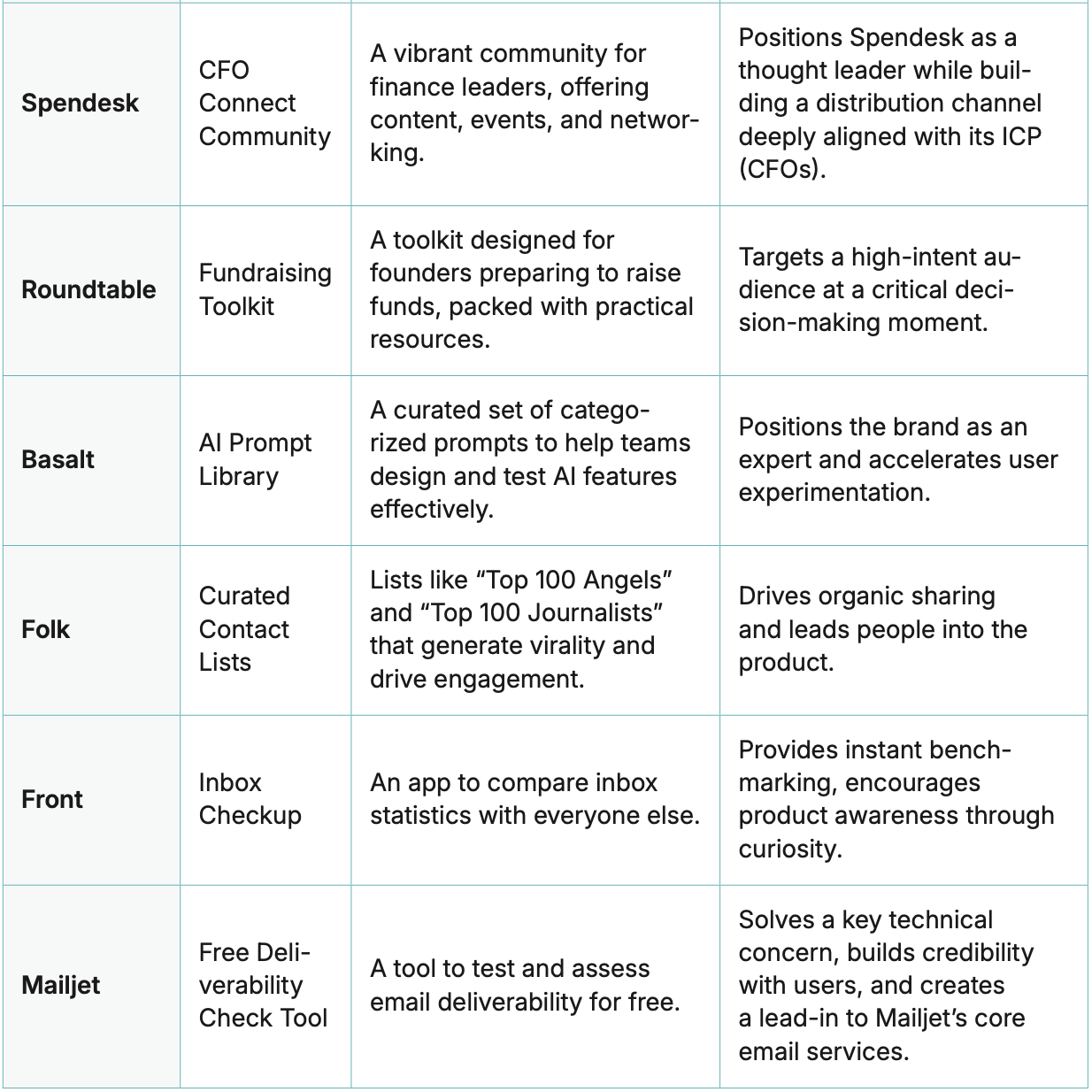
Let’s look at some notable examples of mini-products launched by Hexa companies:

Insight from Simo Lemhandez, CEO and Cofounder of Folk
Companies like Canva, Notion, and Airtable have done this really well with templates. These templates target long-tail search intent and offer unique value aligned with what users are actively looking for.
At Folk,with our “Famous Lists” mini-product, we were quite inspired by products that, based on the problem they solve, can provide real value to users for free, especially value that aligns with search intent. The thinking process we had was:
1. What kind of value can we uniquely offer based on our data or product capabilities?
2. Can this value match a clear search intent that users have?
3. Does this intent signal that users will eventually need a CRM: our product?
So, in the case of Folk, if someone searches for “Best Angel Investors in Michigan” or “Best Web3 Agencies in Sweden,” chances are they’re looking for a curated list and once they have it, they’ll want to enrich it, email those contacts, possibly send a sequence, and manage it all in a pipeline. That’s exactly what Folk helps with.
This led us to build many such curated, qualified lists. We distributed them via SEO, LinkedIn influence, and targeted personas. That strategy alone brought in hundreds of thousands of signups.
The broader lesson is to identify adjacent user needs that signal potential product usage. Deliver value around those needs, and a portion of users will convert.
The myth of PLG
Product-led growth (PLG) is a powerful strategy but it’s far from the only one. A common myth is that PLG means the product “sells itself.” That’s not just inaccurate, it’s dangerous. It gives founders a false sense of security, leading them to avoid building a real GTM motion. And while skipping GTM might feel easier in the short term, it’s a risky bet in the long run.
In reality, PLG and sales are not opposing forces, they are deeply complementary. A successful PLG strategy often creates momentum, but that momentum needs to be captured, guided, and amplified. Even with a viral product, your team may still need to invest heavily in outbound efforts, customer success, and strategic sales to truly scale.
“What does it even mean to be ‘Product-Led’? Too often, founders take it to mean ‘not Sales-Led’ — as if building is somehow more virtuous than selling. But that mindset lets them hide in their comfort zone. They say, ‘We’re product-led, great products sell themselves,’ and then avoid sales altogether. They demonize outbound. They try to solve every problem with more product. And in doing so, they run away from product–market fit. We should stop trying to be PLG. PLG isn’t an identity, it’s a go-to- market motion. There’s no such thing as a ‘PLG company,’ only ‘PLG strategies’.”
– Mehdi Boudoukhane, CEO & Cofounder of Cycle
“We were caught up in the early wave of product-led growth and tried
to mirror Slack’s model. But we were not Slack. The usage behavior and economic units were completely different. With Slite, users come in with a clear goal, set up an internal knowledge base and improve collaboration. If they see value, they pay. If not, they leave.”
– Christophe Pasquier, CEO & Cofounder of Slite
Upflow had a similar experience. They launched a free, lightweight version of Upflow, but they quickly realized that it wasn’t going to sell itself. They realized it was more about product assisted sales than product led growth.
“At first, we imagined it would work like a textbook product-led strategy, where people would discover the tool, sign up naturally, and move smoothly through a conversion funnel, but in reality, it didn’t happen that way, it still required a lot of human interaction - our salespeople calling up doing demos, and personally guiding users through the experience.”
– Alex Louisy, CEO & cofounder of Upflow
Customers without borders
One of the biggest advantages of building software is its global reach - you’re not limited by geography. As long as your product complies with local regulations and addresses real user needs, it can be sold almost anywhere. Yet many European startups limit themselves to local markets far too early.
In the early-stages, you of course won’t open up an international office - but here’s what you can do to sell globally:
Hire native-speaking talent locally
Recruit sales or support reps from key target markets, even if they work from your HQ or remotely. You’ll gain native fluency and market insight without needing a local entity. It’s also a strong move for diversity and inclusion, which we’ll explore later in the ESG section.
“One thing I really recommend is hiring English-speaking locals wherever you’re headquartered before trying to fully set up in the U.S. In the early stages, when you’re only hiring a small number of people, finding a native English speaker locally is much better than having French teams cold-call American prospects with heavy accents and missing cultural references.”
– Alex Louisy, CEO & cofounder of Upflow
Follow your growth
Don’t wait until everything is perfectly in place to expand internationally, follow the momentum. If you’re seeing unexpected inbound interest from a particular country, lean into it.
“Our logic was simple: wherever we had inbound, we did outbound. Our mindset was: why limit ourselves? We’re on the internet, there are no borders... If someone wants your product, why say no just because of geography?”
– Jonathan Anguelov, Cofounder of Aircall
“With a product like CRM there’s no real geographic limitation, which opens up a huge international opportunity. So we built for that from the start. We also naturally developed a strong U.S. focus early on which was largely driven by our Product Hunt launches, where the majority of users discovering us were based in the U.S. Today, the U.S. represents about 40% of our revenue, which confirms the strength of that strategy.
– Simo Lemhandez, CEO and Cofounder of Folk
Get business angels onboard so they can open up markets and connect you to the right people
You’ll find more on this in our discussion with Evan Testa, CEO and cofounder of Roundtable, right after the fundraising chapter. But here’s a sneak peek at the strategy:
“Before entering a new market, I’d go find the right people one year ahead, usually people I knew I wanted on my cap table, and incentivize them early. In Germany, for instance, I connected with key folks, told them, “I’m not launching here yet, but I will,” and brought them in as early believers. By the time we officially launched, they already understood the value, the mission and they became our gateway to that market. Whether they were clients or connectors, they helped with hiring, distribution, and trust-building. It’s local distribution, built-in.”
GTM Rituals
By now, you’ve probably caught on to a recurring theme in this book: rituals are key. To make meaningful progress, your GTM efforts need both structure and cadence. That means establishing two core rituals from the very beginning, quarterly for strategic planning, and weekly for execution.
Quarterly GTM rituals
These are your high-level planning sessions, the moments to define clear goals, align with the broader company mission, and decide where to focus your energy in the upcoming quarter.
OKR guidelines:
Set clear, quantitative OKRs - especially for sales. What exactly do you want to achieve this quarter? Put numbers to it.
Balance two priorities: growing your current accounts and generating new ones. Don’t over-index on one at the expense of the other.
Align your GTM OKRs with your company’s core mission, and more often than not, with your product roadmap. In early-stage teams, GTM often follows product OKRs.
Break down your Objectives into Key Results that are tangible, testable projects. These are your experiments.
Experiment guidelines:
Prioritize experiments that can be built, launched, and measured in under four weeks.
Aim for a mix of inbound and outbound tactics to diversify your approach. Be precise.
Rather than “launch SEO,” try: “Publish a 10-article SEO series focused on construction tenders targeting procurement leads.”
Always justify the experiment: Why is this a priority? Why this audience? What signal are you betting on?
Use a combination of market data and informed intuition. In the early stage, gut instinct often plays a valid role.
Encourage creativity. Early GTM is about testing boundaries, not staying inside them.
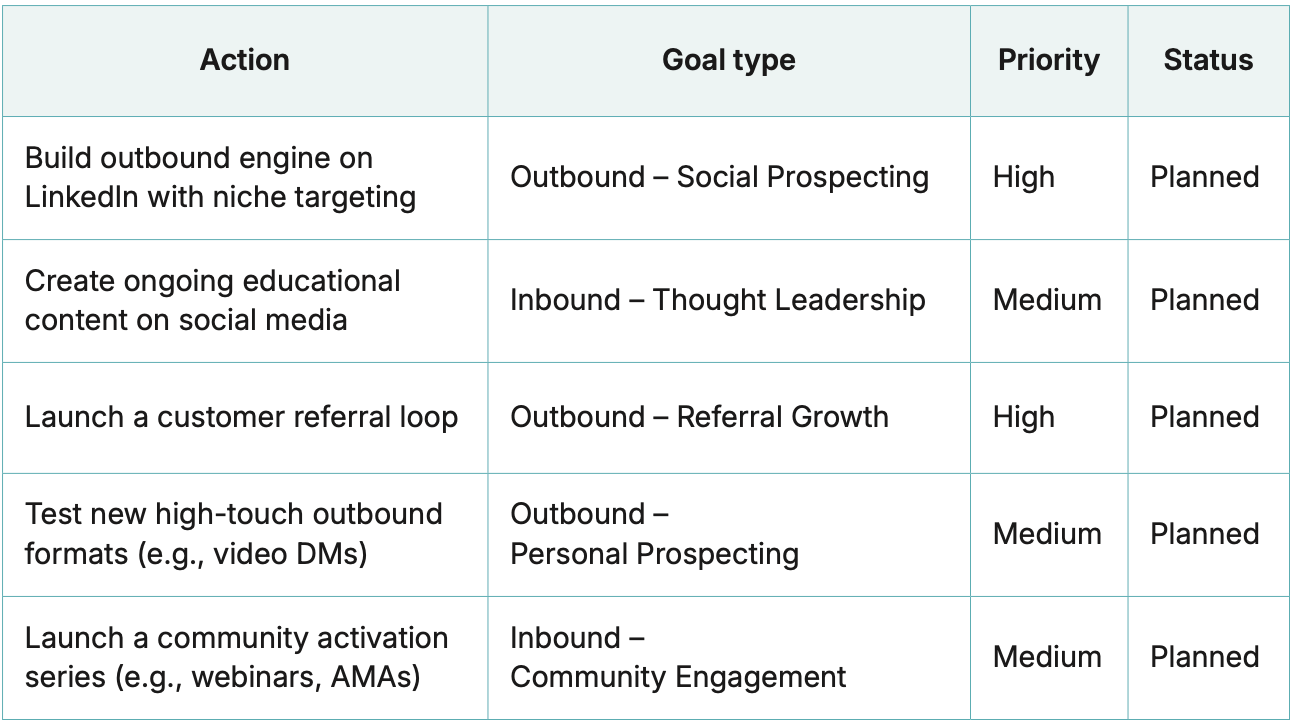
Example of quarterly experiments:
Weekly GTM sprints
Once your quarterly plan is in place, it’s time to shift into execution mode. Each week, you’ll break your experiments into manageable tasks and move them forward.
The goal here is consistency: small, focused actions that compound over time.
Every week, ask:
What are we shipping?
What are we learning?
Are we moving closer to validating or invalidating the experiment?
Do we scale this or do we move on?
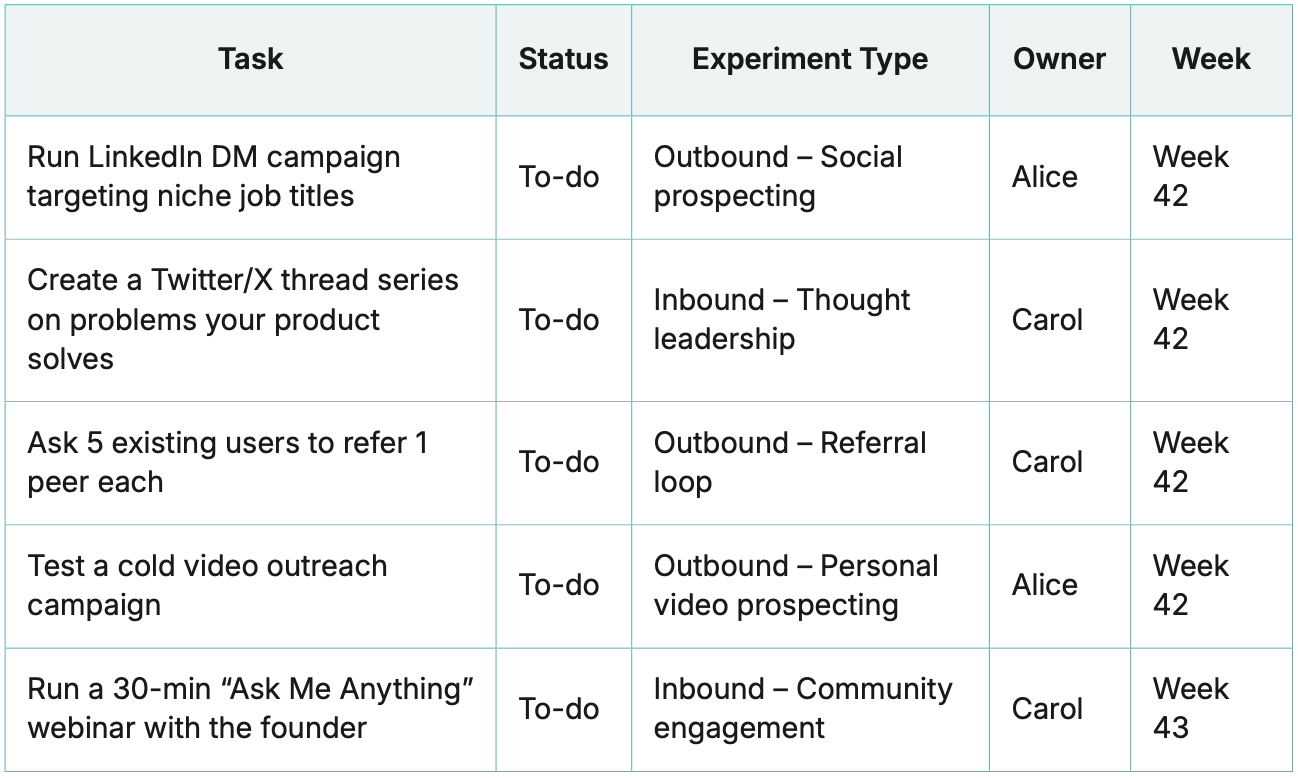
Example of a weekly GTM sprint table: