


We’re publishing a new chapter of The 10x Method every week, our sold-out book detailing Hexa’s early-stage methodology that built 50+ companies, 3 of which are unicorns. You can unsubscribe from future drops here.
Most founders don’t think much about brand in the early days. It doesn’t feel urgent - building, shipping, and fundraising take priority. Brand can seem like something for later, once everything else is in place.
But you already have a brand, whether you’ve thought about it or not.
Customers, investors, partners, they’re forming impressions based on what they see: your landing page, your first deck, a job post, even your LinkedIn bio. Whether or not there was intention behind those things, people are making snap judgments. Who is this company? Do they seem credible? Do I like them? What does using their product say about me?
That’s brand: the feeling people get from what you put into the world. And
in the early days, when attention is scarce and trust is fragile, those signals really matter. If they’re generic or inconsistent, people move on. But if there’s a thread - something clear, confident, emotionally resonant - people are more likely to take you seriously, and even start believing in what you’re building.
There was a time when being modern and simple was enough. Not anymore. Everyone can look modern now. And with AI and faster dev tools, any existing B2B SaaS can be copied or rebuilt in months. As product quality evens out, it’ll be your brand - and the people behind it - that makes people choose you over a competitor.
In this chapter, we’ll show you how to build a strong early-stage brand. From defining your identity and voice to bringing it to life through design, messaging, founder presence, and strategic communication across the right channels.
Why brand matters in the early stage
Brand isn’t just a late-stage concern or a luxury for when you have a marketing team. Your landing page, your first pitch deck, a job post, even your LinkedIn bio - it’s all brand, and they leave important first impressions. You’re trying to earn attention, attract top candidates, get investors excited, convince early customers to take a bet on you… all of that hinges on what they feel when they encounter your company.
There are two primary ways you shape that feeling:
1. Visual identity: how you look. It’s your product interface, your landing page, your logo, your color palette.
2.Communications: how you sound. Across your website copy, social media, investor emails, and even the way you talk to users.
It’s easy to dismiss the importance of brand at the start, especially in B2B. But in B2B, professionals are still human. They don’t show up at work, switch off their emotional brain, and put on a purely rational hat. Professional purchases are human purchases, influenced by feelings: What does this choice say about me? How does it make me feel? What will it signal to my team or industry? When multiple products could meet their needs, the brand that makes them feel something will win.
When the functional differences between products are slim, it’s the brand that evokes the right emotion that wins.
That’s why at Hexa, we push founders to think about brand early. But it’s not about creating a polished, expensive deliverable or 50 pages of brand guidelines no one reads. It should be a focused, intentional effort to signal who you are and why someone should care. At this stage, you’re building a “just good enough” brand. One that creates an emotional hook and helps you stand out.
Defining your brand
Get clear on who you are - really
Consistency is the foundation of every strong brand, but you can’t be consistent if you don’t know exactly what you’re being consistent about.
This is a challenge most early-stage founders face: things move fast, priorities shift, and your story can evolve week to week. One day you’re focused on one angle, the next day it’s something entirely different, and that’s perfectly normal.
But from a branding perspective, it’s essential to commit to a single, clear narrative, at least for a given moment in time. If you try to say everything at once, you risk saying nothing at all. Consistency is what makes you memorable - it helps your audience associate your brand with one strong idea, rather than getting lost in a swirl of mixed messages.
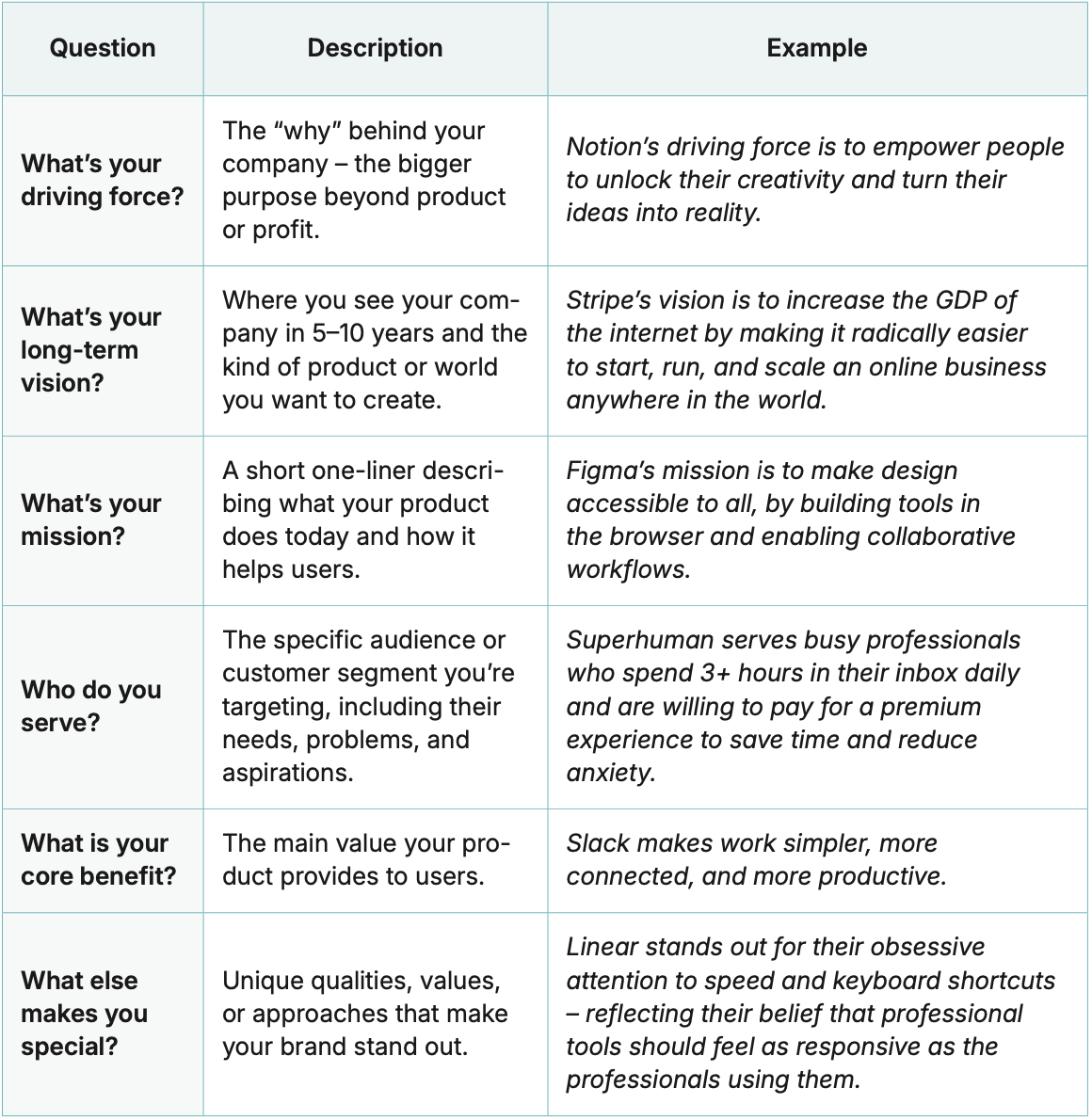
The solution is simple: document your core brand elements in one place to force clarity on a single version of who you are. You can refer back to this document to keep every company action aligned with the bigger picture, from writing your landing page copy to making strategic decisions.
Here’s a template to fill out:
“I think our secret weapon early on was internal alignment. We didn’t intentionally build a brand back then, but looking back, it was strong from the start. We cared deeply about what we were building, and that came through.
I remember sharing a deck early on with a simple diagram, three concentric circles: the team, our customers, and the broader community. The idea was to show how our values, like remote work, CO2 impact, and work-life balance, could radiate outward. It was a small gesture, but it resonated and helped shape how we showed up.
Over time, we heard again and again that customers chose Slite because of who we were and what we stood for, not just the product.”
– Christophe Pasquier, CEO & Cofounder of Slite
Find your brand feeling
Your core brand elements (above) are crucial for alignment and consistency, but your audience will never read your vision statement. Instead, they’ll experience your brand as a feeling. Simply put, your brand feeling is the emotional response you want people to have when they interact with your company. It’s not what your product does, it’s how it makes people feel.
As an early-stage founder, defining this feeling early gives you a major advantage. While you may not have the marketing budget to compete with established players, you can create a distinctive emotional connection that helps you stand out from day one - whether through your product, website, copy, or anything else you put into the world.
You probably won’t get this perfect on the first try, and that’s okay. For early-stage startups, your brand feeling doesn’t need to be polished or permanent. It’s just a starting point that gives you enough direction to be consistent while you’re still figuring things out. You’ll refine it as you learn more about your customers.
Examples:
Spendesk
Spendesk tapped into a feeling of liberation – they free finance leaders from being perceived as mere “spreadsheet people” and elevate them to strategic business partners. Users buy a vision of themselves as valued, strategic leaders in their organizations, not just spend management software.
“We had a few strong convictions early on that we held onto firmly and that ended up shaping our brand in meaningful ways. One clear example was around color: I remember working with an agency on our logo and overall visual identity, and at the time, most companies in our space were using very similar, fairly conservative color palettes.
We decided to break away from that by choosing purple. A choice that felt bold and different back then, even though today purple has beco- me much more common in tech branding. The idea was to make our Spendesk cards stand out: we didn’t want them to look like the usual, traditional black corporate cards that conveyed a very formal image; instead, we wanted something more vibrant and joyful. It wasn’t necessarily the “safe” or conventional choices but those bets paid off, helping us build a brand identity that felt memorable.
At some point, it became more than just branding: people would lite- rally pull out their purple Spendesk cards and proudly say, “I’m with Spendesk,” which for us was a clear sign that the brand had truly reso- nated.”
– Rodolphe Ardant, cofounder & CEO at Spendesk
Swan
Swan evokes a feeling of quiet empowerment – they help businesses offer financial services without surrendering their own brand identity to a bank. Their approach is built on the philosophy that “it’s about you, not us.” While traditional financial services dominate the experience, Swan steps into the background, allowing businesses to remain authentically themselves while gaining new capabilities. They’ve transformed what could be a purely technical service into something more meaningful: the ability to extend your brand into financial experiences without compromise.
“It’s easy to focus solely on things like product in the early days, but investing in brand early can be just as important. At Swan, one of the most impactful decisions we made was hiring a key brand leader early on. That hire helped shape Swan’s tone of voice and identity in a way that made the brand stand out, especially in a fintech space where most companies sound the same.”
– Nicolas Benady, cofounder & CEO at Swan
Turning it into a voice
Once you’ve defined the feeling you want to create, choose 2–3 adjectives that describe how your brand should speak to evoke it. For example, if your brand feeling is creative freedom (like Figma), your voice might sound: encouraging, approachable and a bit playful.
Each adjective should support the emotional experience you’re aiming for. “Encouraging” language helps people feel more free and capable. “Playful” gives people permission to loosen up a bit. Together, they reinforce the feeling you’re trying to create.
You don’t need a full set of brand guidelines at this stage, just a few clear voice adjectives can provide enough direction to shape your tone across everything: landing page copy, social posts, job descriptions, even how you respond to customer support tickets.
Bringing your brand to life - Visual Identity
One of the biggest worries founders have is: does building a good brand mean spending a ton of money? At this stage, no, it really doesn’t.
You can DIY 90-100% of your early brand, which makes sense when things are still evolving. Being scrappy now doesn’t mean settling for a sloppy result, it just means being smart about what actually matters.
Your name
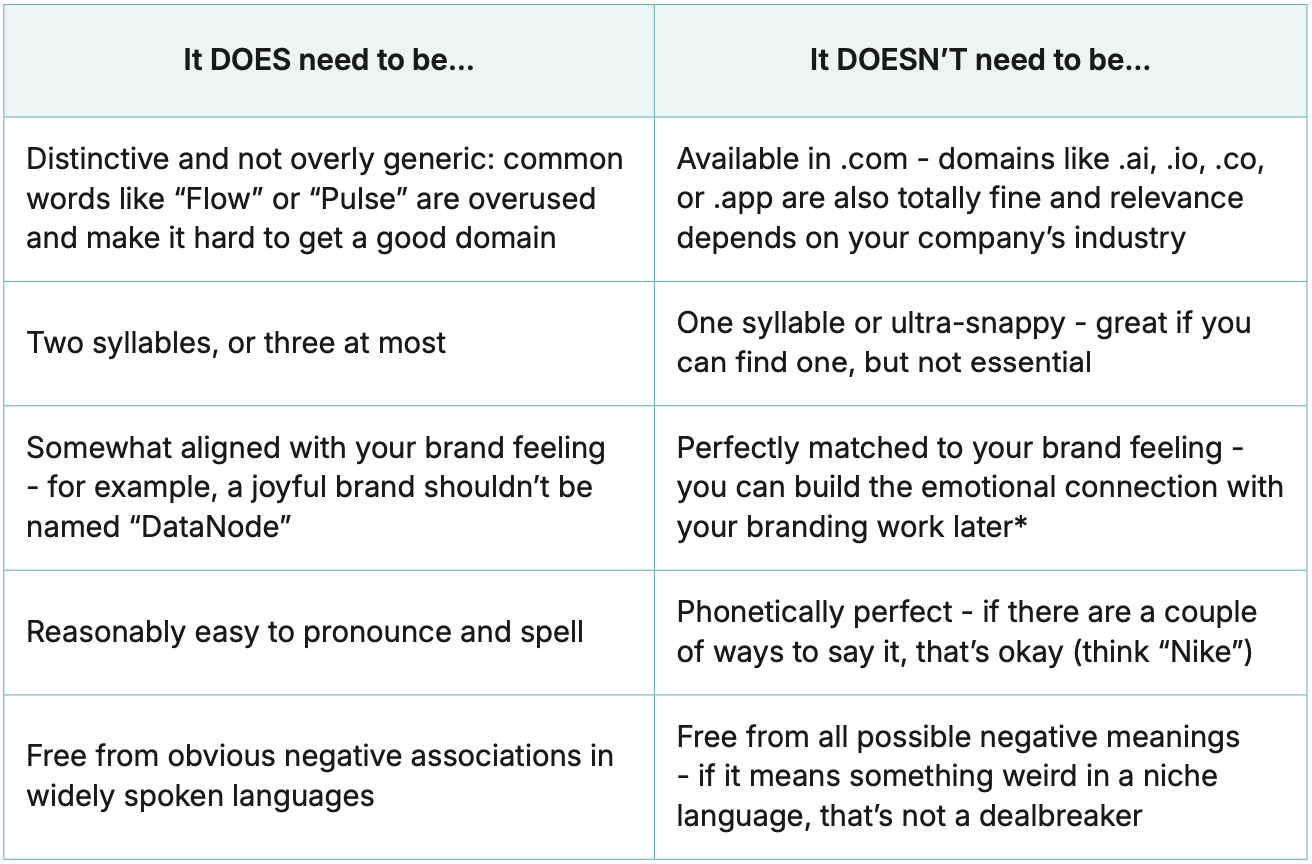
While not visual in itself, your name is a crucial element that will strongly influence your visual identity - particularly the logo, which in many cases needs to visually represent the name. Naming your company can easily send you into endless loops. Yes, it needs to tick a few boxes, but not as many as you might think. Founders often put way too much pressure on finding the “perfect” name. The truth is that unless it’s actively bad, people get used to it. And if you do the brand work right, you’ll create meaning around it over time. The goal is finding a ‘good enough’ name that you can build on.
Here’s a quick breakdown of what your name does and doesn’t need to be:
“The name Swan came to us quickly and it just felt right. It captured the essence of what we wanted to build, something elegant but powerful. It also fit the naming trends we admired at the time: short, simple, starting with ‘S’ like Swile, Stripe, Shine. But more than that, it had emotional resonance. It was a name people would remember and feel something about.”
– Nicolas Benady, cofounder & CEO at Swan
Where and how to show up
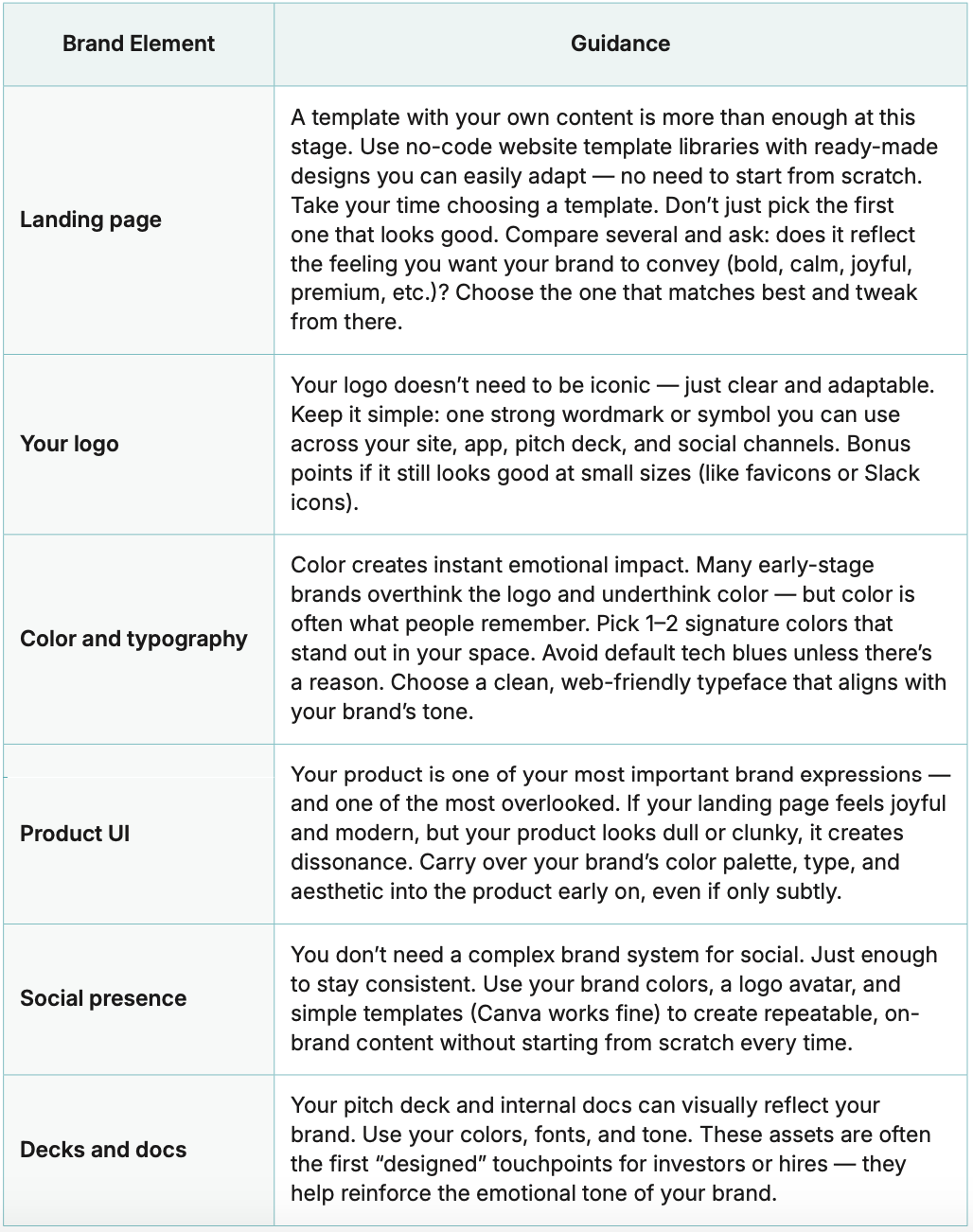
Early on, your visual identity doesn’t need to be fancy, just clear and consistent. A simple logo and a basic color palette will take you a long way.
You can absolutely do this yourself using tools like Figma or Canva. Choose 1–2 signature colors that stand out in your space, pick a clean font, and keep it consistent across everything. If you’re using a website template, you can even start with the default styles and tweak them to suit your brand.
If you’ve got a bit of budget (even under €5K), consider working with a free- lance designer. There are plenty of talented ones who offer high-quality work at reasonable rates. A good freelancer can help you quickly pull together:
A simple but professional logo
A basic graphic system (font, color, layout rules)
A lightweight style guide or Figma kit that makes it easy to apply consistently
Let’s walk through the essential visual brand touchpoints, the places where your design shows up.
Working with freelancers
If you manage to DIY everything, that’s amazing. But if you’re struggling and you have a small budget to spare, you should consider working with a freelancer or a small studio agency. Keep the large agencies for later on as you scale and need more strategic work.
Finding the right freelancers is about smart networking. Start by asking other founders, especially those with brands you admire, who they worked with. Most are happy to share their contacts, and this comes with the added benefit of a built-in reference.
Online platforms like Dribbble and Behance are gold mines for finding designers with specific aesthetics.
Once you’ve found someone promising, the success of the project hinges on your communication. Create a simple brief that clearly outlines what you need, when you need it, and why it matters to your company. Share the brand foundations and feeling you’ve already worked on - this strategic work will save them a lot of time, and you a lot of money.
Provide concrete reference points by sharing 3-5 examples of brands that capture elements of what you’re looking for, with specific callouts of what you like about each. “We love how this feels approachable but still technical” is much more helpful than “make it modern.”
Bringing your brand to life - Comms
Defining your core message
Earlier in the chapter, you defined your brand elements - your vision, mission, benefits, and what drives you. That work gives you internal clarity. But when it comes to communicating with the outside world, you need a core message.
It’s not a tagline or a sentence to slap on every slide or web page, but the thread that runs through all your comms. It’s the one idea you want people to walk away with, whether they’re a customer, candidate, investor, or friend of a friend.
It can show up in many different words, but it almost always shows up in spirit.
A strong core message communicates:
1. Who you are
2. Why you’re different
3. Your brand feeling
You’ll refine this message over time, and you might adapt it for different au- diences. But early on, one clear message is enough.
Examples:
Spendesk
“Where finance connects” – Reframes Spendesk as more than a tool, it’s the connective layer between finance teams, employees, and spending decisions. It speaks to trust and collaboration in one elegant line.
Swan
“Banking features that feel like product, not infrastructure” – Captures a strategic shift: finance is no longer just a backend layer, it’s something your users experience directly. Swan enables companies to embed branded fi- nancial features into their product quickly and seamlessly, making embedded finance part of your value proposition, not your tech stack.
Aircall
“The only phone system that feels like your other SaaS tools” – Aircall behaves the way modern teams expect software to behave: fast to set up, easy to use, and built to work seamlessly with the rest of your stack. This positions it as the phone system designed for the SaaS generation, not a relic from the telecom past.
Getting your message across
Once you’ve defined the message you want to get across, the next challenge is making sure they actually hear it and hear it in the right places.
You don’t need to be on every channel. In fact, spreading yourself too thin early on usually backfires. What matters most is being intentional: showing up where your audience already spends time, in formats they naturally engage with.
One common mistake people make is starting with the channel. You de- cide you want to launch a podcast, or start a blog, or write a newsletter then scramble to find something to say. That approach is backwards.
Instead, start by defining the message first, that way, you can make a more intentional decision about which channels are best suited to deliver it, whether that’s:
Website
Social media
Blog
Newsletter
Podcasting
Youtube / video
PR
Live demos
Events
...
Not every message belongs on every channel. Some things are better suited to quick, skimmable formats like LinkedIn. Others need longer-form content like a blog post, podcast, or founder letter. The key is matching your message to the format that will carry it best.
And don’t overcomplicate it. Early on, you only need one or two channels. Pick the ones where your audience is most active and where you’ll actually follow through.
Channel spotlight: your website
Your website is one of the most powerful places to communicate your key messages. It’s often the first (and sometimes only) place where users, candidates, or investors will encounter your company, which makes it your single most important brand touchpoint.
Start with your tagline
Your tagline is usually the headline on your landing page, the first thing people see. It should clearly express the core benefit of your product (refer back to your ‘brand elements’ doc to find it) while reflecting your brand feeling. Here’s what makes a good early-stage tagline:
Clear: no jargon or clever wordplay that hides the point
Benefit-led: focus on what the user gets, not what you’ve built
Emotional tone: calm, bold, empowering, urgent — whatever fits your brand feeling
Short: aim for 5-8 words
Structure to follow
Here’s a suggested structure to follow that can be adapted to the specificities of your business.
Hero: Your tagline, 1–2 supporting lines, and a clear call to action
Social proof: Logos, testimonials, or early traction to build credibility
Benefits: The key benefits of/use cases for using your product, e.g. “proto- type quickly”
Key features: 3–4 features with light visual support (icons, screenshots) How it works:
A simple 3-step overview of the user journey
Call to action: Repeat your primary CTA
FAQ: Pre-empt questions and remove friction to conversion
Tips to keep in mind
Don’t try to say everything - focus on what converts best
Lead with outcomes – your headline should tell people what they’ll gain
Write for skimmers – use clear headers, bullets, and short paragraphs Prioritise benefits over features – talk about them, not you
Stay aligned with your brand feeling – what emotion do you want to provoke in people?
Keep it human – use simple, confident language
Be ruthless – only include what helps someone say yes
Channel spotlight: founder branding
In the early days of your startup, your personal brand as a founder is often your most powerful marketing channel. While your company is still unknown, you are immediately visible and accessible.
Your personal presence is the approachable entry point that draws people in before they fully understand your product.
Align with your brand’s feeling, but stay authentic
Your personal brand should exist in the same universe as your company’s brand, but it doesn’t need to be identical. If your company’s feeling is about empowerment, you don’t need to become a caricature of empowerment in your personal presence.
The most effective approach is to find the natural overlap between your authentic self and your company’s values. Your personal content might be more casual, more opinionated, or more playful than your company’s voice - and that’s perfectly fine.
Tell your story
Your personal story (why you started the company and what problem you experienced) is one of your most valuable brand assets. It humanizes your company and creates connections in ways that talking about your product can’t.
To tap into your founder story in a way that aligns with your brand:
Identify the emotional core: What feeling drove you to start this company? Frustration? Inspiration? Determination? This should connect to your desired brand feeling.
Find the relatable moments: Which parts of your journey will resonate most with your audience’s own experiences?
Connect past to present: Show how your personal history directly shaped your company’s approach or values.
Keep it authentic: Share genuine challenges alongside victories, perfect stories are less believable and relatable.
Remember that you’re building two parallel but connected brands - your personal reputation and your company’s identity. When managed deliberately, they strengthen each other, creating more entry points for people to discover and connect with your vision.
Insight from Thibaud Elziere, Partner and Cofounder at Hexa
Starting a project or building a company is, above all, about convincing others to join a shared adventure. It’s about channeling your passion and energy whether it’s to rally co-founders, inspire early employees to take a leap with you, win over first users to test your beta product, reassure investors taking a financial risk, or attract media interest.
A huge part of being a founder is the ability to communicate and share your vision. That’s why developing a strong personal brand is essential. Here are a few key principles I believe in.
Authentic alignment
Everyone has their own way of being visible. Not all of us gravitate toward the same topics or have the same communication style. For a while, blogging was the go-to for founders sharing their entrepreneurial journey. That worked for some but it’s far from a one-size-fits-all solution.
The most important thing is to find a format and channel that matches who you are. You also need to understand your deeper motivations, your personal mission, and your vision.
Take Paul Graham. He chose long-form essays on his blog to educate the tech ecosystem. Others are active on X (formerly Twitter) because they enjoy sparking conversations. Some found their voice through podcasts, interviewing founders and VCs as a way to learn, reflect, and share insights. Others thrive on stage, preferring conferences and in-person talks.
Personally, it took me a while to find the right channel. But I eventually connected with my audience on LinkedIn, using a casual, authentic tone. It’s also been a powerful tool for hiring.
What matters most is that there’s a genuine alignment between who you are and how you express yourself. That authenticity is what creates real connection.
Consistency over time
Like most things, results come with consistency. Find your sweet spot and stick with it. Building an audience takes time and energy. Even in the age of social media and viral reach, it often takes years to become truly visible.
The biggest influencers didn’t emerge overnight, it’s the result of habits practiced over years. There will be moments of doubt, and times when publishing feels like a chore rather than a joy. But those are the moments when real progress is made.
The best thing you can do is create a routine that forces you to show up regularly. Most platforms reward consistency. Your cadence will depend on the format: a daily story on Instagram, one or two LinkedIn posts per week, a weekly podcast, a quarterly blog post - it doesn’t matter, as long as it’s consistent.
The upside? You get better with practice. If you’ve chosen the right format for your strengths, it will start to feel natural. There’s real joy in finding your rhythm, when ideas flow easily and words come without effort.
And remember: consistency doesn’t mean rigidity. As you grow, your tone, your themes, and your positioning will evolve. Staying true means staying aligned with who you’re becoming.
Diversify thoughtfully
I firmly believe you should focus on one primary channel. That’s where the compound effect kicks in: the more audience you have, the easier it becomes to grow it further. With the right format, the right channel, and regular effort, you can create real resonance.
But it’s also important to stay open to external opportunities that broaden your reach. Journalists, influencers, partners, they can introduce you to new audiences, which you can then bring back to your main channel.
Make time for these opportunities: an interview in a print publication, a podcast guest spot, a conference talk, a TV appearance. Choose them wisely. Be selective about who amplifies your voice, your personal brand is at stake.
Lastly, remember: personal branding isn’t a monologue. One-way channels are a thing of the past. Today, it’s all about listening, engaging, and creating meaningful dialogue. Every platform allows for this: use them to build a community that’s alive, loyal, and participative.
Channel spotlight: PR
PR is obviously an important lever in any GTM strategy, particularly when it comes to driving inbound interest and creating early momentum around your product. In that sense, this section could easily sit within the GTM chapter. However, PR also plays a broader, longer-term role. It’s not just about short- term traction, but about shaping perception, building credibility, and increasing brand awareness over time. PR is especially valuable in the early stages of
a startup, when you’re still building trust. A well-placed article or feature in a reputable publication can act as powerful social proof. At a time when no one has heard of you yet, earned media can help reinforce what your brand stands for, and bring that story into circles you wouldn’t reach on your own.
Be genuinely helpful
Start by identifying journalists who regularly cover your industry. Read their articles, understand their angles, and get familiar with the topics they care about. If you notice gaps in their reporting or have insights that could deepen their coverage, don’t hesitate to reach out—share constructive feedback, offer data, or connect them with experts in your network.
The goal is to build a relationship before you need something. Position your- self as an expert voice in the space. When the time comes to pitch your own news, they’ll already know who you are and how you think about the industry. The most effective relationships with the press are built on mutual value, not transactional asks.
How to get them interested
When you’ve got something to announce and want press coverage, the first question to ask yourself is: is this truly newsworthy? Journalists aren’t going to write about your first sales hire. And unless you’re a tiny startup landing a major, high-profile customer, that alone likely won’t make the cut either. What might get coverage? Things like a significant product launch, a noteworthy fundraising round, or traction that signals a broader trend. But even then, it has to be positioned well and actually stand out.
Also, remember: journalists aren’t here to provide free advertising for your startup, they’re here to write stories that matter to their audience. That’s why it’s crucial to understand who that audience is and tailor your pitch accordingly.
Here are a few tips to help cut through the noise and connect with journalists who receive hundreds of pitches every day:
Uniqueness - What makes your news genuinely new or different from anything else out there? Why are you uniquely positioned to solve this problem better than anyone else?
Relevance - How does your story tie into a broader industry shift or cultural trend? Go beyond what your product does for your users, frame it in terms of a growing problem or unmet need that many people or companies are starting to face.
Humility - Avoid buzzwords and vague claims. Especially in a climate saturated with AI jargon and overblown promises. Journalists can spot fluff from a mile away, make every word count.
Expertise - Demonstrate a strong grasp of your industry. If you can position yourself as a credible voice (not just about your product, but about the space as a whole) journalists will start to see you as a go-to expert. That means they’re more likely to come back to you for quotes or background on future stories.
Keep in mind: a funding announcement alone might not be enough to spark interest. What’s unique about your investors, your timing, or your market? Are you solving a pressing, widely felt problem in a new way? Are you riding, or resisting, a major trend? The sharper your angle, the better your chances of getting picked up.
Example: Roundtable
Rather than simply announcing their €3M seed round, Roundtable crafted a compelling narrative: “100 business angels from across Europe back a new way to fund startups.” This angle aligned perfectly with their brand mission and tapped into ongoing discussions about early-stage investing. Their clear messaging secured substantial coverage across major tier-one publications.
Be clear on your angle
Imagine this: if you could choose the headline of the TechCrunch article that features your startup tomorrow, what would it be?
That’s the level of clarity you need. Your ideal headline should guide how you craft your press release and how you pitch your story. It should appear in your subject line, your opening paragraph, and be echoed throughout your messaging.
Journalists ultimately decide how they frame a story but if you’re unclear about your positioning, you leave that framing entirely in their hands. And that can lead to a message that misses the mark or fails to resonate.
The clearer and more compelling your angle, the more likely it is to be picked up and accurately represented.
Pitch yourself
Early on, you don’t need a PR agency. In fact, most agencies aren’t a good fit before Series A, they’re costly. At this stage, you don’t need polish, it’s best for you to start building relationships and pitch to journalists.
Start with:
1. A short, authentic pitch
Write a concise email:
Clearly lead with your news and why it matters.
Explain your product simply, in one or two sentences.
Include a link to the press release in your email (more details below).
Zoom out: Why is this relevant right now? What’s the bigger shift you’re part of?
2. A thoughtful target list
Look at coverage your competitors received. Who covered them?
Read recent pieces from those journalists. Understand what resonates.
Prioritize media your ideal audience genuinely reads, including industry-specific outlets.
3. Personalize every email
Mention something specific the journalist wrote.
Keep it brief, conversational, and buzzword-free.
Offer interviews, data, or insights that genuinely add value to their readers.
Sending 5–10 thoughtful emails is infinitely more effective than blasting out dozens of generic pitches.
Make journalists’ lives easier
Journalists are juggling tight deadlines and overflowing inboxes, so the less friction you create, the more likely you are to get coverage.
Here’s how:
Prepare a press release (a Notion doc works fine) that’s easy to reference and written in the right tone:
Keep it neutral and factual — Press releases must be written in the third person, using clear, impartial language. Avoid opinions, feelings, or hype.
Use quotes to express opinions — If you want to include emotion or pers- pective, do it through quotes (typically from the founder, a customer, or an investor). Keep it to 2–4 concise, impactful quotes max.
Lead with the essentials — Start with the most important facts: who, what, when, where, and why. Keep the entire release to one page with a strong, clear headline.
Include a media kit with all the assets a journalist might need: founder bios, product screenshots, company logo files, key facts and figures, customer testimonials, and anything else that makes their job easier.
Be available and responsive if they follow up with questions or request an interview. Timeliness matters.
Don’t micromanage their work once the story is published, only reach out to correct factual inaccuracies. Respect their editorial independence.
For high-priority announcements, consider offering an embargo - a way for journalists to prepare their piece ahead of time, with a clear publication date. It shows you understand their workflow and builds professional trust.
When to get help
For early-stage founders, hiring a full-scale PR agency is rarely worth the cost. But working with a freelance PR consultant can be a smart move, especially in situations like these:
You have no idea where to start, you’re short on time, have no media contacts, and you need someone to maximize the impact of your first big announcement.
You’re getting a sudden surge of journalist interest, with lots of inbound requests, and you’re unsure how to prioritize or respond strategically.
You’ve landed opportunities for live interviews (TV, radio, panels) and need media training to present confidently and stay on message.
You’re planning an international announcement and need help localizing your press release or connecting with media in other regions.
That said, always stay actively involved in your messaging and outreach. No one knows your story better than you do, and journalists often prefer hearing directly from founders. A PR freelancer can help you refine your story, manage logistics, and open doors—but don’t outsource the relationship-building. Taking the time to build direct connections with journalists is one of the most valuable long-term PR investments you can make.
The one question that matters
Whether you’re pitching a journalist, designing your landing page, or creating content, the success of your brand ultimately hinges on one question:
“What do I want people to feel when they encounter my company?”
This single question cuts through the complexity, turning abstract concepts into concrete choices. So as you build your brand in these early days, keep coming back to this question. Let it guide your choices, big and small. Your answer might evolve as you learn and grow, but the question itself will always be your most valuable brand asset.