



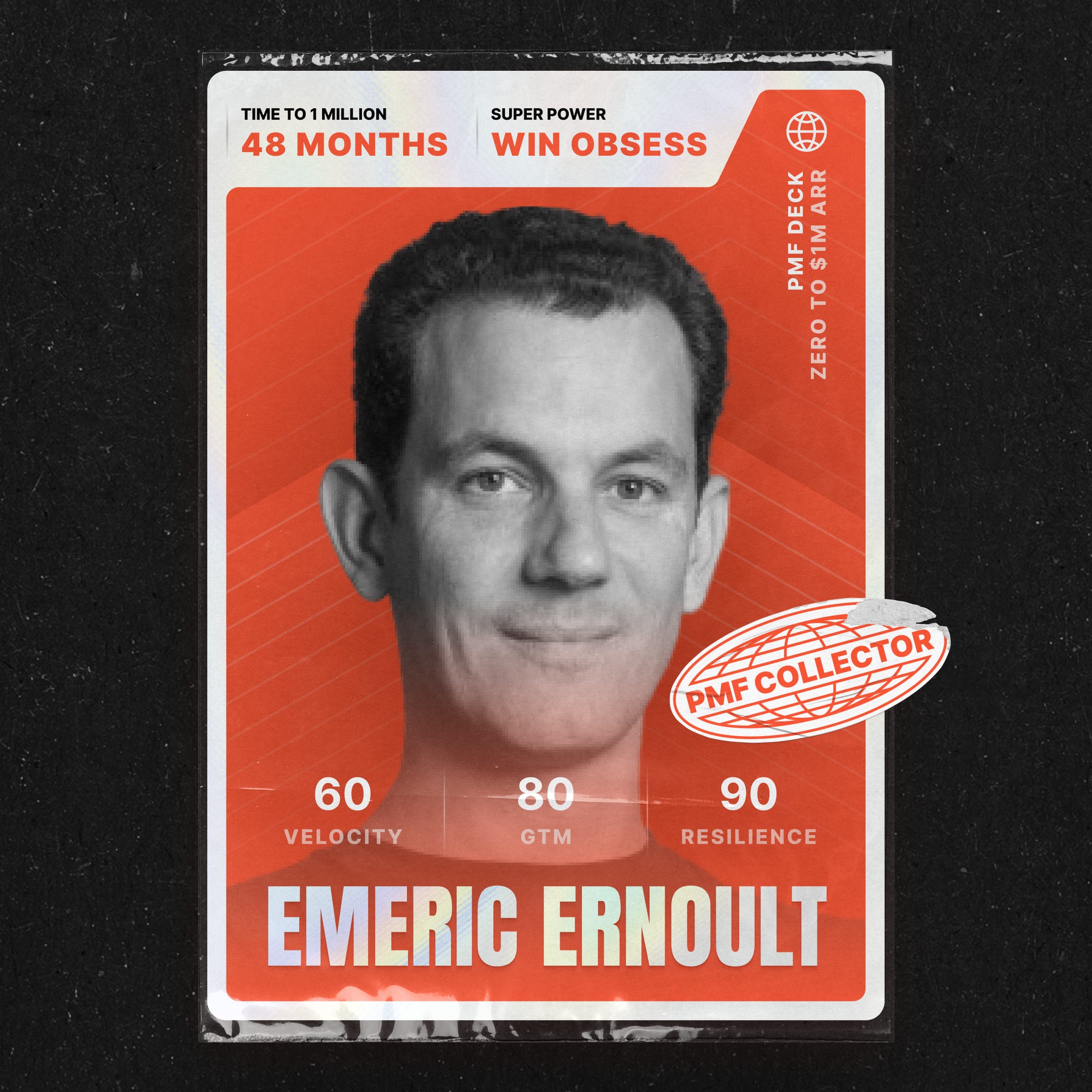
For this episode of PMF Collector (ex Start Mode), Matthieu Vaxelaire sits down with Émeric Ernoult, co-founder & CEO of Agora Pulse - the #1 social media management tool in France, and the 5th largest worldwide, built without raising a single euro.
It took 15 years. A failed first company. Two men working evenings and weekends for a decade. A co-founder relationship that survived 24 years, therapy included.
But what makes this conversation worth your time isn’t the destination. It’s the honesty about how ugly the road actually was.
You can watch the full conversation above, or read the key themes below.
1) The co-founder you didn’t choose — and why it worked anyway
Émeric didn’t meet Benoît at a startup event or through a warm intro.
They crossed paths at a student house in New York in 1993, during their first internship in the US. Years of reconnections followed — Paris, Washington, chance encounters through Benoît’s twin brother — until 1999, when both were back in Paris, restless, and caught up in the internet bubble.
“We made three PowerPoint slides and thought we’d become multi-millionaires.”
They didn’t. But they stayed together for 24 years — longer than Émeric’s marriage.
2) Ten years of evenings and weekends — and why he doesn’t recommend it
From 2000 to 2010, both founders kept their day jobs.
Émeric worked at a law firm. Benoît at a web agency. Their startup — Affinity, a white-label community platform — ran on whatever hours were left. Morning commutes, Saturday afternoons, Sunday evenings.
At peak, the business was doing €150K in annual revenue. After a decade.
“It should have died. We should have moved on. It wasn’t normal what we did.”
He doesn’t romanticize it. The model was broken — every client needed custom development, it was agency work dressed up as a product, and it never scaled. But something kept them going: the belief that the next pivot would be the one.
3) The insight that created Agora Pulse: sell what people use every day
In 2010, they stumbled into Facebook contest apps by accident — a campaign for the FIA featuring Sébastien Loeb went viral, and suddenly brands were calling.
They sold bespoke Facebook contests at €15,000 each. Within a year, fifty agencies were doing the same thing in Paris, and prices collapsed to €6,000. Then lower.
Meanwhile, they noticed a US startup called Wildfire productizing the exact thing they were doing manually — turning it into a self-serve platform. Google later acquired it for $450M and shut it down within a year.
The real question wasn’t contests. It was: what do community managers actually use every day?
“We asked ourselves: who are our buyers, and what do they need constantly — not once a year?”
The answer was a publishing and engagement tool. And that became Agora Pulse.
4) The ultimatum: 1,000 customers at €49/month — or we shut it down
By late 2011, Émeric was done with uncertainty.
He set a hard target: 1,000 paying customers at €49/month within one year. If they missed it, he was walking away. He’d spent too long, earned too little, and couldn’t keep convincing himself the breakthrough was coming.
It took three years, not one. But every single month — except December and August — the number went up. Three new customers. Four new customers. Slow, but always forward.
The thing that kept him going was a talk by Gail Goodman, founder of Constant Contact, called The Long, Slow SaaS Ramp of Death. Her message: the only question that matters is whether you’re moving in the right direction. Not how fast.
“Every month it progressed. Two months a year it went backwards. That was enough to hold on.”
5) Bootstrapped to €23M ARR — and what that actually costs
Agora Pulse never raised a meaningful round. A €250K grant from a public fund. That’s it.
By 2015 they crossed €1M ARR and reached profitability. By 2016, they grew 150%. By 2019, 90%. Today the company sits around €23M ARR, with 160 employees across France, the US, and internationally.
But Émeric is clear: the growth wasn’t linear. 2017 was nearly flat — Benoît spent the year rebuilding the entire tech stack from scratch, and zero new features shipped. When you stop shipping, customers stop growing.
“Once you’re profitable, the emotional rollercoaster is less violent. But you never feel like you’ve arrived. That’s the nature of the job.”
6) Building on someone else’s land — the risk nobody talks about
The existential vulnerability of a social media tool is obvious once you say it out loud: everything depends on Meta, Twitter, LinkedIn keeping their APIs open.
Émeric has lived through accidental outages that froze €23M in ARR for days at a time, with no clear escalation path, waiting for an engineer in India to push the right button.
“My next company will not be built in someone else’s garden. I know that for certain.”
The diversification across multiple platforms helps — losing one network doesn’t kill the business. But the dependence on Meta in particular remains a structural risk he carries every day.
7) Twenty-four years with one co-founder — the honest version
Émeric and Benoît never did the thing advisors tell you to do: write down what each of you expects, read it back, sign at the bottom.
They fought constantly. They went through stretches of barely speaking. At one point, they hired a coach — couples therapy, essentially — to get back to a functional working relationship.
What saved them wasn’t process. It was a deliberate decision Émeric made about how to look at his partner.
“I decided to look at him as the person without whom none of this exists. Full stop. The rest doesn’t matter.”
His advice to founders pairing up today: write down your expectations before you start, revisit them every quarter, and give each other actual feedback. He admits he never did any of it properly. That’s exactly why he knows it matters.
8) The one thing he’d fix if he started over
Émeric Ernoult’s answer comes from the book he’s writing.
The biggest mistake he made — consistently, across fifteen years of hiring — was bringing people on without ever defining precisely what success looked like for them. Not a vague job description. Not a list of KPIs. A specific, co-authored document that the person reads, agrees to, and can be held accountable against.
He calls it a What Does Success Look Like document.
“We spend so much time hoping people will figure it out on their own. They don’t. Because we never told them what ‘good’ actually means in their role.”
He’s been running this at Agora Pulse for eight years. He believes it’s the single biggest lever most founders leave untouched.


